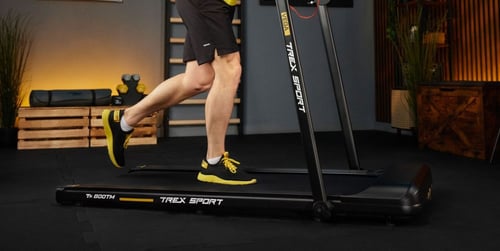
The speed you set on the console shapes a session more than any preset programme. How fast do treadmills go? Home machines cover everything from a slow walk (4 km/h) to around 16 km/h, and that top speed decides whether you can walk, jog or run properly. The display counts more than speed, though: distance, pace and pulse come from different systems, and they rarely agree with your watch. Here is how to read them!
Where the numbers on your console come from:
- Home ceilings sit between roughly 4 and 16 km/h, following the motor and the frame
- Gym machines carry more speed headroom, with no single industry maximum
- Hop-Sport treadmills cover four separate ranges, from a 6 km/h walking pad to a 16 km/h folding model
- Console units depend on the model and its settings, so check the display before trusting a distance
- Pace and pulse come from simple maths and a hand-contact reading, both best used to compare your own sessions
How Fast Do Treadmills Usually Go? (Home vs Gym Treadmills)
Domestic machines cover a slow walk at 1 km/h up to 12 to 16 km/h, and the top speed depends on the motor and the frame, not on the brand. A 1.5 HP motor stops nearer the bottom of that band; a 2.0 HP unit leaves room for a genuine run. Our HS-2000LB Joger runs 1-16 km/h with 15° of incline, which changes the effort far more than the last two kilometres per hour ever will. That is the practical answer to what speed do treadmills go up to in a living room.
Machines built for commercial gyms are a different class of equipment. They offer more speed headroom, on longer belts and heavier frames meant to run all day, so “how fast do gym treadmills go” has no single industry answer.
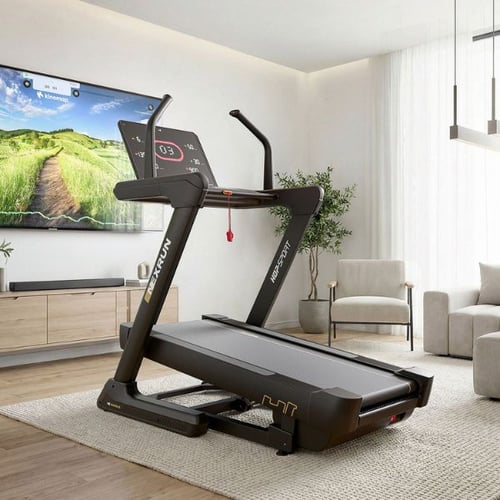
How Fast Do Walking Treadmills Go?
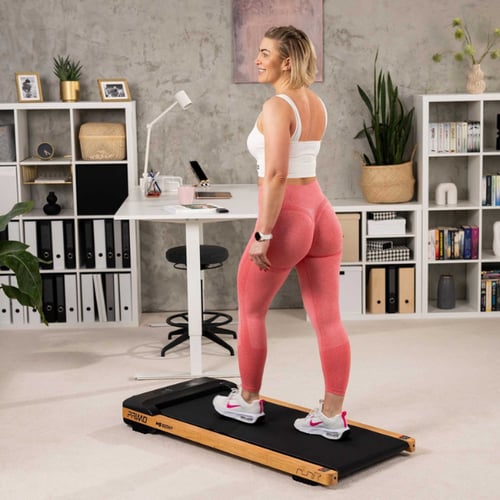
Walking pads sit in a much narrower band than a running machine because steady movement asks for a different deck and motor. The answer to “how fast do walking treadmills go” is usually 1 to 6 km/h, and that ceiling is deliberate. Our HS-650WP Revo stops at 6 km/h and stands 11 cm high, so it fits under a desk and lets you add steps while you work.
What Is a Typical Treadmill Jogging Speed?
Somewhere between 7 and 10 km/h is where most recreational running settles, though those bands are practical guides rather than physiological rules. A workable treadmill jogging speed is the one where you can still speak in short sentences while the belt moves. The point at which walking turns into jogging shifts from person to person, and leg length, fitness and how the day has gone all move it.
What Speed Should I Run on a Treadmill?
The right speed matches the session you planned, not what someone else shares online. Progress comes from small, repeatable steps – half a kilometre per hour added to a familiar effort tells you more than one fast minute you never repeat.
A simple way to spread speeds across a training week:
- Easy sessions at a speed you could hold in conversation for most of your weekly minutes
- Shorter, faster blocks of one to three minutes, with the belt slowed right down between them
- Incline instead of speed when your legs want to work without a higher number on the display
Changing one variable at a time makes it clear what is working. Move speed, incline and duration at once and no console figure tells you what improved.
Are Treadmills in KM or Miles? Understanding Your Console Units
The model and its settings decide “are treadmills in km or miles”, not a fixed national standard. Plenty of consoles sold in the UK offer both, some switch through a menu, some are fixed. Product cards state speed in km/h, which is the number you dial in; the distance unit is worth confirming on the machine itself.
A 5 in miles is a very different session from a 5 in kilometres – check “what do treadmills measure distance in” on your console first. One mile equals 1.609 km, so a 5 km run lands just over three miles. Check the unit once, note it, and every session after that compares cleanly with the last.
Treadmill Speed to Pace: How to Convert Your Running Speed
60 ÷ speed in km/h gives minutes per kilometre – the one sum behind converting treadmill speed to pace. Race plans, running apps and training partners all use pace, while the treadmill console shows speed, so knowing both lets you set a treadmill running speed that matches your outdoor target.
Speeds you will actually use, translated into pace:
- 6 km/h – 10:00 per kilometre, a steady walk
- 8 km/h – 7:30 per kilometre, an easy jog for many people
- 10 km/h – 6:00 per kilometre, a round number worth remembering
- 12 km/h – 5:00 per kilometre, the classic reference pace
- 14 km/h – 4:17 per kilometre, usually used for intervals
- 16 km/h – 3:45 per kilometre, a short, sharp effort
Memorise the two or three you use most and every session becomes comparable with your outdoor running. Anyone setting up a first machine can weigh motor power against speed range across our range of treadmills before deciding which ceiling their training needs.
Are Treadmills Accurate for Distance and Speed Tracking?
A console reports the movement of the belt over time, and it does so consistently, which makes it an excellent reference for comparing one of your sessions with the next. Controlled treadmill testing has found measured belt speed staying close to the selected figure, with loading and belt wear creating small differences between machines. When people ask “are treadmills accurate for distance and speed”, the fair answer is that the reading is belt-based: the distance shown is the distance the belt travelled beneath you.
A watch disagreeing with the console is normal. Indoors, a watch estimates from wrist motion and a stride model while the treadmill counts belt speed against time – different methods, different estimates. Calories sit in the same category, since that figure is always an estimate built from assumptions about the person training.
Managing Your Average Heart Rate When Running
Effort, age, fitness and medication all move the number, so no single average heart rate when running fits everyone. Several of our treadmills carry tactile sensors in the handles, giving an indicative reading while you keep both hands on the sensors – a quick check partway through a session rather than continuous monitoring.
Getting something useful out of the pulse reading:
- Hold both grips for several seconds before reading anything, keeping the contact steady
- Compare with yourself across weeks at the same speed, not against someone else's figure
- Trust the effort when breathing and the display disagree, especially during faster blocks
Pairing the reading with how the effort feels gives a better picture than either signal alone.
Choosing a Speed Range That Fits Your Training
Speed ceilings only matter in the part of the range you actually use, which is why a 6 km/h pad and a 16 km/h folding machine can both be the right buy. Once you know what your console counts, dial in a speed, note the pace it converts to, and compare sessions on the same machine.
Four ceilings, four kinds of week:
- 6 km/h – the walking-pad ceiling, built for desk-side steps
- 12 km/h – where a 1.5 HP motor tops out, walks through steady jogs
- 14 km/h – headroom for quicker continuous runs
- 16 km/h – a fast 3:45 per kilometre pace, suitable mainly for intervals
Pick the ceiling your training will really use and start logging sessions!
FAQ: Most Common Questions About Treadmill Speed
What Speed Should a Beginner Start at on a Treadmill?
A comfortable starting point is a brisk walk of around 5 to 6 km/h, held for a few minutes before anything faster goes on the display. Building from there in half-kilometre steps across several sessions is better for your motivation than a hard first week.
How Do I Turn 10 km/h into a Running Pace?
Divide 60 by the speed in kilometres per hour, so 10 km/h works out at exactly 6:00 per kilometre. The same sum handles every other setting, which is why 12 km/h works out at an even 5:00 per kilometre.
Why Does My Watch Show a Different Distance to the Treadmill?
The two devices measure in different ways, since a watch indoors works from wrist motion and a stride model, while the treadmill counts belt speed against elapsed time. Treating them as separate records, each compared with itself over time, avoids a lot of pointless worry.
Do I Need a Higher Top Speed or More Incline?
Incline usually delivers more useful training for the space it takes, because it raises effort without demanding a faster belt or a longer stride. A higher top speed earns its place when you run intervals regularly and genuinely reach the current ceiling.
Author: Hop-Sport Team