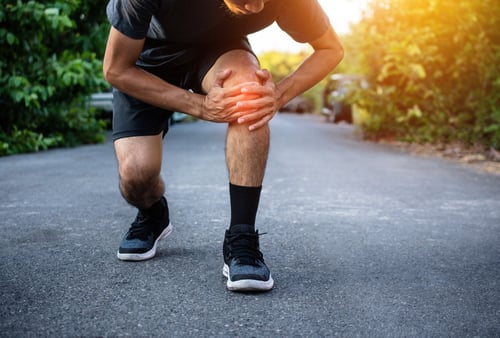
Are treadmills bad for your knees? Almost every home runner asks this sooner or later, usually after a dull ache shows up on the stairs following a longer session. The answer rarely sits in the machine itself – it sits in what you control: how fast your mileage grows, how quickly the belt turns, what is on your feet and how much recovery sits between runs. This guide takes those factors one at a time, compares indoor and outdoor running, and shows where a cross trainer fits. Read on and set your week up properly!
What decides how your knees feel:
- Training load – sudden jumps in distance matter more than the machine
- Belt speed – faster settings raise peak forces, but the picture is not one-way
- Injury history – a previously injured knee needs a gentler build-up
- Shoe comfort – a good fit matters more than the category printed on the box
- Recovery – what happens between sessions is part of the training
Is Running Bad for Your Knees in General?
Recreational runners do not turn up with more knee arthritis than people who never run, which is not the same as calling running risk-free. Cartilage does react to a session: it compresses and then returns to where it started within a couple of hours, and that short-lived change is not the joint wearing away. The wider question, is running bad for your knees, has a fairly settled answer for healthy joints as long as the build-up is sensible.
Where you run changes the setting rather than the biology. A belt keeps the surface identical from the first stride to the last, and that repeatability is the practical difference between treadmills and a route through the park. Consistency helps while you are still learning what your legs tolerate, because only one thing moves at a time.
What Causes Knee Pain When Using a Treadmill for Running?
Most knee pain that shows up on a belt traces back to how much running was added recently, not to the machine under your feet. The same three culprits keep coming up: previous injury, training load and the way an individual moves. A treadmill for running is easy to use every day, and that convenience is precisely what makes creeping overload easy to miss.
The factors worth checking first:
- Volume spikes – one session far longer than anything in the past month
- Speed changes – jumping to a pace your legs have not practised
- Old injuries – a previously injured knee reacts sooner than a healthy one
- Too little recovery – hard days stacked with nothing easy between them
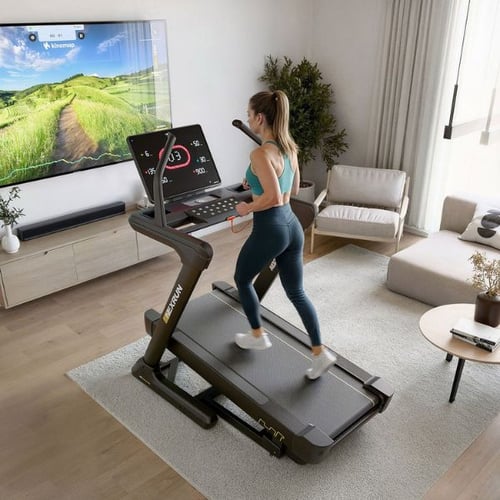
Repeated discomfort works better as a prompt to review the week than as proof the machine is at fault. If it keeps returning, worsens mid-session or arrives with swelling, ease off and consult a GP or physiotherapist – doing that early is far more useful than a month of pushing through.
Treadmills vs Outdoor Running: Which Has Less Impact?
Neither option is clearly easier on the joints. Indoors and outdoors measure closer together than most people assume, and not always in the direction you would guess – machine, belt, speed and shoes all move the numbers. That makes impact a poor single yardstick for choosing where to run, and the plan answers "is running on a treadmill bad for you" better than the surface does.
Where the two settings genuinely differ:
Factor | Treadmill indoors | Outdoor running |
Surface repeatability | The same belt under every stride | Changes with pavement, path and camber |
Pace control | Set on the console and held | Drifts with terrain, traffic and fatigue |
Terrain variation | Flat unless an incline is selected | Hills, kerbs and corners appear naturally along the route |
Weather and time of day | Sessions run to plan in any month | Daylight, rain and wind shape the run |
A treadmill at home holds a set pace to the decimal, and every treadmill we stock starts at 1 km/h, so slow and controlled is genuinely available rather than theoretical. Outdoor running naturally adds variation (kerbs, camber and hills), which is welcome once your legs are used to the work and less welcome in week one.
Can the Right Running Shoes Protect Your Knees?
Comfort and fit are the measures that hold up when choosing running shoes, while the promise that one category shields a joint does not. Shoe trials have never produced a clear winner for injury rates, and matching a pair to a static foot type has not changed those numbers either, so the pair that feels right from the first minute is the sensible pick.
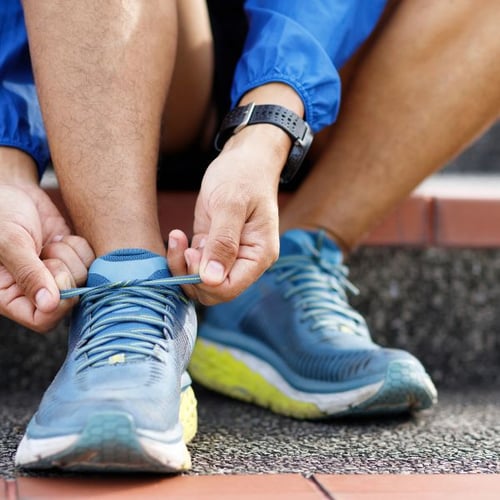
What actually matters when you pick a pair:
- Fit first – a thumb of room at the front, no heel slip
- Day-one comfort – nothing needs breaking in to feel right
- Session match – walking asks less of the foot than running does
- Midsole age – foam softens long before the upper looks worn
- Warm feet – try shoes late in the day for a true size
- Past pairs – a model that has always felt good is a better guide than a size chart
Cushioning also sits in the machine. The HS-800LB Dorn in our range lists shock absorbers in its cushioning system and runs 1-12 km/h on a DC 1.5 HP motor, which covers a walk through to a steady jog. What that system does is dampen shocks in the deck; what it cannot do is decide how much running your legs are ready for.
Is a Cross Trainer Good for Knees?
A cross trainer changes how the legs are loaded rather than taking the load away. People asking "is cross trainer good for knees" usually want the landing phase gone, and the pedals do remove it – but knee torque stays, and it climbs as the cadence rises. An elliptical machine keeps hips and knees moving through one long arc, so the hip flexors work steadily instead of in short bursts.
Treating it as a second cardio pattern is more useful than ranking it above running. Anyone training around bad knees tends to get more from alternating the two than from picking a side, and we keep both categories in stock – the elliptical cross trainers sit right next to the treadmills. Two patterns in one week also spread the demand across different muscles.
The Importance of Rest Days and Recovery
Adaptation happens between sessions rather than during them, which is why rest days should be part of the plan, not an afterthought. Sports medicine keeps coming back to the same two factors in running injuries: load and recovery. Putting one easy day after a demanding one costs almost nothing and keeps the following week available.
Three habits that keep the week repeatable:
- Space hard days – something easy, or nothing at all, between them
- Watch the jump – a run far longer than recent weeks is the classic trigger
- Sleep and food – the least visible part of recovery matters the most
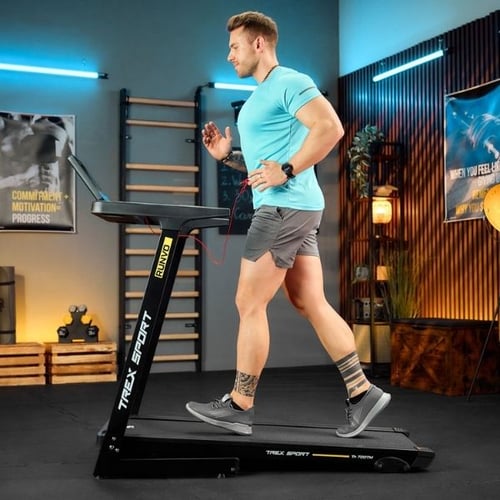
None of that needs a rigid formula, and the popular habit of adding a fixed percentage every week is a rough guide rather than a guarantee. Build in steps your own legs have already shown they can handle.
Running on a Treadmill with Your Knees in Mind
Knees respond to what you ask of them, and the machine is only one part of that request. Grow distance gradually, keep an easy day near every hard one, run in shoes that felt right from the first minute, and treat repeated discomfort as information rather than something to push through. When running is not the pattern you want every week, an elliptical stride gives you a second way to keep the cardio going. Put our treadmills and cross trainers side by side, compare the speed ranges and the space each one needs, and pick the machine you will actually look forward to using!
FAQ: Most Common Questions About Treadmills and Knee Pain
Does Treadmill Cushioning Change How a Run Feels?
A cushioning system built from shock absorbers dampens shocks in the deck, and most people notice that as a softer, quieter stride. It is a comfort feature of the machine rather than a promise about what a joint will do.
How Quickly Should Treadmill Runs Get Longer?
Add distance in steps your recent weeks have already prepared you for, and avoid making one session dramatically longer than anything you have run lately. Progression is individual, so a fixed percentage works better as a reminder to be patient than as a rule.
Is a Cross Trainer or a Treadmill Better for Daily Cardio?
Neither is better in general – they load the legs differently, and the one you use consistently will do more for your fitness than the one that looks ideal on paper. Plenty of people keep both in rotation and switch depending on how the legs feel that day.
Can Walking Replace Running on Tougher Days?
Walking keeps the routine going when a run feels like too much, and a brisk pace on the belt still adds up across a week. It is a different session rather than a lighter copy of a run.
Author: Hop-Sport Team