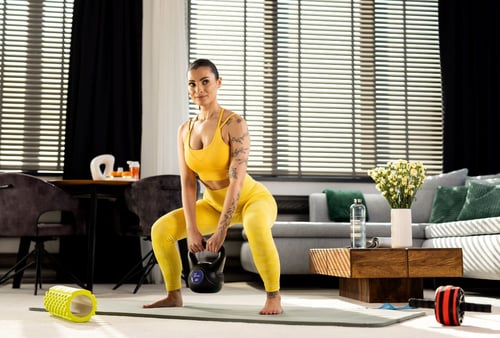
The kettlebells goblet squat is a powerhouse move that looks deceptively simple yet transforms the way your body moves and feels. It’s a true staple for anyone wanting stronger legs, better balance, and functional strength that carries over to everyday life.
What is a kettlebell goblet squat?
The kettlebell goblet squat is a compound resistance exercise that integrates a squat movement with a kettlebell held by the horns or base at chest height. First popularised by strength coach Dan John, this exercise requires minimal equipment yet delivers broad neuromuscular activation throughout the lower body and core musculature.
How the goblet squat with kettlebells differs from a traditional squat
Unlike the traditional barbell squat, where the barbell loads your spine from behind and permits a forward torso lean, the goblet variation cradles the weight at the chest to enforce upright alignment and self-limit loading capacity. This design bypasses rack dependency, prioritises flawless technique through natural feedback, and distributes stress more evenly across the kinetic chain. Practitioners thus achieve safer, rack-free sessions with emphasis on controlled depth over sheer power.
Kettlebell goblet squat benefits
The kettlebell goblet squat offers key benefits that improve training efficiency and long-term progress.
- Superior core stabilisation: The anterior load challenges the midsection to resist flexion, fortifying abs and obliques for better spinal integrity during dynamic activities.
- Increased functional mobility: It improves hip hinge mechanics and ankle dorsiflexion, translating to enhanced performance in sports and daily tasks.
- Scalable progression: Beginners start light to master form, while advanced users add pauses or tempo variations for intensified challenge.
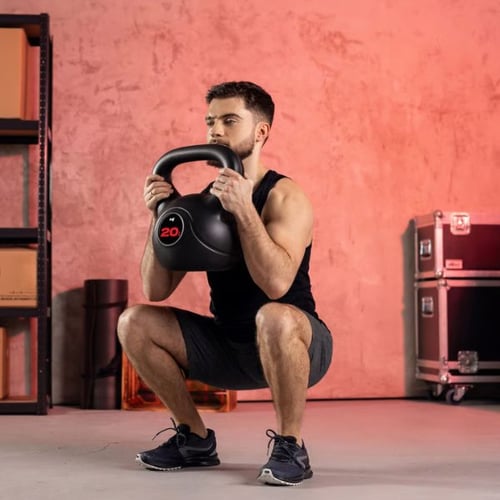
Regular practice builds durable lower-body strength and power
Kettlebell goblet squat: Muscles worked
The kettlebell goblet squat targets a broad spectrum of lower-body musculature while recruiting stabilisers across the core and upper body for optimal execution.
- Quadriceps: These drive knee extension during the ascent, bearing primary responsibility for power output from the bottom position.
- Glutes and hamstrings: Glutes propel hip extension at the top, while hamstrings assist in controlling descent and stabilising the posterior chain.
- Core muscles (abs, obliques, transverse abdominis): Anterior loading demands isometric bracing to maintain spinal neutrality and resist forward collapse.
- Upper back and lats: Holding the kettlebell close to your chest engages these to help keep your torso upright.
- Adductors and calves: Inner thighs facilitate knee tracking, and calves contribute to ankle stability through the full range.
This multi-joint activation fosters balanced strength development essential for athletic performance and injury resilience.
Step-by-step guide to proper goblet squat form
Mastering proper goblet squat form helps you get the most out of the exercise and minimises injury risk through precise technique and body awareness.
Optimal grip and stance
Select kettlebells weight that challenges you for 8-12 repetitions while maintaining control. Grip the kettlebell by its horns or by the base with both hands, positioning it snugly against your chest at sternum height, creating a stable front rack that promotes an upright torso. Adopt a stance with feet shoulder-width apart or slightly wider, toes turned out by about 15-30 degrees to align with natural hip rotation and allow knees to track over toes without inward collapse.
Correct movement pattern
Initiate the descent by pushing your hips back as if sitting into a chair, simultaneously bending your knees while keeping your chest lifted and elbows aligned inside your knees at the bottom. Lower until your thighs reach parallel to the floor or slightly below, ensuring your weight stays centred over your midfoot for balance. Drive up powerfully upwards by driving through your heels and midfoot, fully extending hips and knees at the top while squeezing your glutes, then reset with a braced core before the next rep.
Common goblet squat kettlebell mistakes to avoid
During the kettlebell goblet squat, avoid rounding your lower back or letting your chest drop forward, which compromises spinal integrity. Counter this by actively pulling your elbows down and bracing your core throughout.
Do not allow your knees to cave inwards, instead, focus on spreading the floor with your feet to maintain outward pressure.
Avoid rising onto your toes or shifting weight forward onto your forefoot, as this destabilises the movement. Keep tension in your heels to anchor the pattern securely.
Kettlebell goblet squat variations
Kettlebell goblet squats offer numerous variations to target specific muscle groups, address mobility limitations, or increase intensity, ensuring progressive overload without monotony. Explore these adaptations to customise your training.
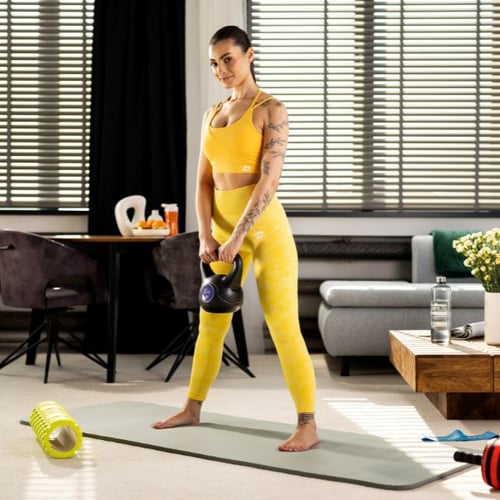
- Double kettlebell front squat: Hold two kettlebells in the rack position at shoulder height to increase the load, demanding greater upper-body strength and core bracing for heavier lifts.
- Single-arm front squat: Grip the kettlebell with one hand to introduce asymmetry, challenging anti-rotation stability and identifying imbalances between sides.
- Sumo goblet squat: Widen your stance with toes pointed out further to emphasise inner thighs, glutes, and abductors while reducing knee-forward travel.
Elevate heels on weight plates for quad focus if ankle mobility limits depth, or add pulses at the bottom for a greater burn and extra metabolic stress. These tweaks maintain the exercise's foundational benefits while aligning with advanced goals like hypertrophy or power development.
FAQ about the goblet squat with kettlebell
As the kettlebell goblet squat constitutes a compound exercise engaging multiple muscle groups, numerous questions arise about how to perform it.. These frequently asked queries address key concerns to help you perform it safely and effectively.
What kettlebell weight should beginners use?
Beginners should select a kettlebell weight that challenges them for 10-12 repetitions while maintaining proper form, typically ranging from 8-16 kg depending on body size, gender, and prior experience. Women often start with 8-12 kg, while men may begin at 12-16 kg to prioritise technique over load. Progress gradually by increasing weight only after achieving consistent form and control.
How regularly should I do kettlebell goblet squats per week?
Incorporate kettlebell goblet squats 1-2 times per week to allow adequate recovery while building strength and technique. This frequency suits beginners, enabling progressive overload without risking overtraining. Adjust based on your overall programme, ensuring at least one rest day between sessions.
Is the kettlebell goblet squat safe for beginners?
Kettlebell goblet squats prove highly safe for beginners, as the front-loaded position promotes an upright torso and natural movement patterns that reduce lower back strain. The exercise teaches core engagement and proper squat mechanics, minimising common errors like excessive forward lean. Start with body weight practice to build confidence before adding weight.
How deep should I go in a goblet squat?
Aim to lower until your thighs reach parallel with the floor or slightly below, provided you maintain a neutral spine and control. This depth maximises muscle activation in the quads, glutes, and hamstrings without compromising form. If mobility limits you, elevate your heels or focus on gradual improvement rather than forcing depth.
Does the goblet squat aid fat loss?
Goblet squats can contribute to fat loss by elevating heart rate, burning calories during the workout, and building muscle to boost resting metabolism. As a compound movement, they engage multiple muscle groups, enhancing overall energy expenditure when combined with a calorie deficit. Integrate them into high-volume circuits for amplified fat-burning effects.
Author: Hop-Sport Team