
A weighted vest earns its place when you already move regularly and want the usual walk or circuit to cost more effort. Five or ten kilos across the torso lifts your heart rate on exactly the same route, without adding a minute to the schedule. That is where the real benefits of weighted vest training sit: in effort you can feel, on days already booked for training. It also explains why weighted vests keep turning up in home gyms next to dumbbells and kettlebells. This guide covers what the vest changes in a session, how it behaves on walks and runs, and what to check before buying one!
What this guide sorts out:
- How it works – the vest adds load to your torso, so the same pace costs more oxygen and more effort
- Where it shines – hills, stairs, walking intervals and bodyweight circuits more than flat strolls.
- Hop-Sport vests – two fixed loads, 5 kg and 10 kg, both neoprene with sand spread evenly through the panels
- Fit first – an 80-114 cm chest range and a double fastening keep the load still while you move
What Does a Weighted Vest Do, and How Does It Work?
A vest sits on the chest and back and makes the body carry extra mass through every step, squat, and press-up of a session. Walk your usual loop in one, and the heart works harder, breathing deepens, and the same distance burns through more energy. What do weighted vests do to an ordinary workout? They raise the cost of it while the session itself stays exactly as it was, which is why weighted vests keep turning up in home gyms next to dumbbells and kettlebells.
Inside the Hop-Sport Build: Sand, Neoprene, Reflective Strips
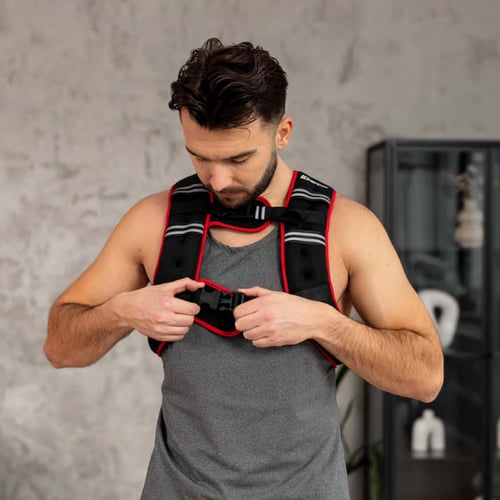
In our range, the Weighted Vest 5 kg holds its sand filling spread evenly across the whole panel, so the weight stays evenly distributed and does not shift during faster movement. Neoprene keeps it soft against the ribs, reflective strips help on early starts, and a small rear pocket takes a key or a card. A weight vest and a weighted vest are two names for the same piece of equipment.
Top Benefits of Using a Weighted Vest in Your Daily Workouts
One piece of equipment increases the difficulty of many exercises you already do. Step-ups, lunges, press-ups and walking intervals all become more demanding as soon as you put it on. Your muscles have more to stabilise, so simple bodyweight moves start behaving like light strength training.
Where a vest makes the biggest difference:
- Same route, more effort – the walk you do anyway costs you more without taking any longer
- Affordable progression – bodyweight sessions keep progressing without extra equipment
- Hands stay free – nothing occupies your grip, so arm swing and balance stay natural
- Stronger engagement – the trunk works harder to hold you upright, which shows up in posture and stability

Do weighted vests work the way people hope? They make ordinary sessions more demanding, which is exactly what they are designed for. The trick is picking the right sessions for them – the ones where a little more effort actually helps.
Do Weighted Vests Help You Lose Weight?
Adding load raises the effort of a session, and that effort counts towards what you burn across a week. A brisk hour with an extra 10 kg requires more effort than the same hour without it, which is a genuine help when the goal is weight loss. Research on vests is careful about the bigger picture, and so is anyone who has coached this for a few months.
Do weighted vests help you lose weight on their own? Treat the vest as a way to make walks you already do count for more, while training frequency, sleep and food still set the pace. Used that way it slots neatly into a routine: weighted walks on days when you have more time, regular walks on the rest.
Are Weighted Vests Good for Walking and Running?
Walking is where a vest slots in most easily, and running is where it asks the most in return. A weighted vest for walking pays off best on hills and stairs, where the extra kilos meet gravity and the effort climbs sharply. On flat pavement at an easy pace the difference is smaller than most people expect.
Easy ways to start with a vest outdoors:
- Pick the hill – add the vest to a route with a climb rather than to your flattest loop
- Keep it short – twenty loaded minutes beat an hour spent fighting the straps
- Watch the posture – leaning forward is a sign it is time to finish the session
A weighted vest for running is more demanding because every stride lands with more load going through ankles, knees and hips. Keep those sessions short and rare at first, on soft ground where you can, and build from there. If you would rather hold the weight in your hands for part of the week, our kettlebells give you another way to add load – carries and swings work well as a complement to vest training.
The Pros and Cons of Weighted Vests
Are weighted vests worth it? For anyone who already walks or trains a few times a week and wants those sessions to be more challenging, the answer is usually yes. A vest is quick to put on, works with kit you already own, and can be stored on a hook and takes up no floor space. It also pairs well with resistance training: heavier squats in the rack on one day, loaded step-ups and carries on another.
The honest other half is that added weight means more work for legs, back and core, so add load slowly and let your form be the deciding factor. „A vest will not replace a training plan or regular workouts. How heavy to go is a question of its own, big enough to deserve its own guide rather than a throwaway line here.
How to Choose a Weighted Vest
Three things decide whether a vest gets used or ends up in a cupboard: how the load sits, how securely it fastens, and how it feels after twenty minutes. Some adjustable weighted vests on the market let you add or remove small weights, while others arrive at one set load and stay there. Our two models sit in the second group – 5 kg and 10 kg, with straps that adjust the fit rather than the weight.
What to check before you buy:
- Load distribution – filling spread across the panels keeps the vest stable while you move
- Fastening – a double system holds everything still during jumps and quick turns
- Material – neoprene sits softly against the ribs and takes sweat without complaint
- Chest range – check the span covers you over a t-shirt and over a winter layer
- Visibility – reflective strips matter when training happens before sunrise
- Storage – a small rear pocket saves carrying a key or a card in your hand
Once the fit works, the load is the only real decision left. The Weighted Vest 10 kg is the heavier version of exactly the same build, with the same 80-114 cm chest range, so anyone who has outgrown a lighter vest gets identical handling with twice the load.
How Should a Weighted Vest Fit?
A vest should sit snug but not tight: close enough to stay put when you jog on the spot, loose enough that breathing feels normal. Both models adjust between 80 and 114 cm, and the double fastening stops the panels from drifting sideways once the session gets going. Tighten it until the vest moves with you, then check you can take a full breath without effort.
Making a Weighted Vest Work for Your Routine
A vest is one of the cheapest ways to make training you already enjoy harder: no new programme, no extra hour, just more effort packed into the same walk or circuit. It suits hills, stairs and bodyweight sessions, with no extra machine in the hallway. Start short, keep an eye on posture, and let the load feel normal before you think about more. Browse our weighted vests and pick the load that matches the sessions you already look forward to!
FAQ: Most Common Questions About Weighted Vests
Can Beginners Use a Weighted Vest?
Beginners get on well with a vest as long as the first sessions stay short and the walking pace stays comfortable. Ten to fifteen minutes on a familiar route is plenty at first.
How Often Should You Train in a Weighted Vest?
Two or three vest sessions a week leave your body time to adapt in between, which is usually enough to notice a difference within a month. The rest of the week is better spent unloaded, so your normal pace and stride stay intact.
What Is the Difference Between a Weighted Vest and Holding Dumbbells?
A vest spreads the load across your torso and leaves both hands free, so arm swing stays natural and grip never becomes the limit. Dumbbells load the same body through the hands, which suits some exercises better and others far less.
Can You Wear a Weighted Vest All Day?
Vests are designed for training sessions, not for all-day wear, so the sensible pattern is to put one on for the walk or circuit and take it off afterwards. Wearing extra weight for long periods strains the back and shoulders without real benefit.
Author: Hop-Sport Redaktion