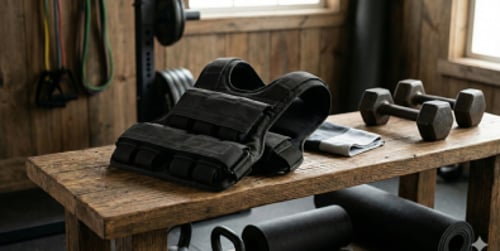
Most people should start a weighted vest at around 5% of body weight, which puts 5 kg in the right zone for anyone between roughly 70 and 100 kg. Push that to 10 kg and the maths shifts fast: near 10% on a 100 kg frame, closer to 20% on a 50 kg one. What weight weighted vest should I get? It comes down to that percentage, not to how strong you feel on the day. Work through the numbers below and pick your load with confidence!
The numbers, in short:
- About 5% of body weight is the usual starting load, not the heaviest vest you can tolerate
- 5 kg works out at roughly 10% at 50 kg, 7% at 70 kg and 5% at 100 kg
- Walking takes load far better than running, where the light end wins
- Fit before kilos – a panel that shifts on every stride is wrong whatever it weighs
- Ten minutes makes a good first session; time comes before extra weight
How Heavy Should a Weighted Vest Be for Beginners?
Roughly 5% of body weight is the sensible first target, and it sits lower than most people assume they could handle. Coaches keep landing on that figure because they see what happens when someone straps on too much too early: posture drops, the stride shortens, and the session stops being fun. A Weighted Vest 5 kg sits close to that mark on a 100 kg body and a little above it at 70 kg, with sand spread evenly through the neoprene instead of packed into one lump.
Where 5 kg and 10 kg land on different bodies:
- 50 kg body – 5 kg is about 10%, already a real load for a first month
- 70 kg body – 5 kg comes to roughly 7%, right inside the starting zone
- 100 kg body – 5 kg is about 5%, and 10 kg moves things up to around 10%
- New to load – ten minutes of walking is plenty for the first outing

Most beginners are almost always better off with the lighter one. We keep the range to two loads, 5 kg and 10 kg, precisely so the decision stays simple: begin with the lighter vest and move up to the heavier one once you have built a base.
How Heavy Should a Weighted Vest Be for Walking?
Walking handles added load better than almost any other session, so 5 to 10% of body weight suits most people once the first outings have gone smoothly. The extra mass shows up as a harder-working heart on exactly the same route, and hills multiply that without any change of pace. A weighted vest for walking works best on stairs and long steady routes rather than on a flat ten-minute stroll.
How heavy should a weighted vest be for walking? The route decides: gentle pavement takes the heavier end, a steep climb feels like plenty at 5 kg. Most weighted vests are built for precisely this kind of work, with straps that hold the panel still while the arms swing freely. Keep the first loaded walks to twenty minutes and let the load feel comfortable before adding time or kilos.
How to Choose a Weighted Vest for Running
Running is the one place where the light end of the range is not a compromise but the right call. Extra mass changes how the foot lands and how long it stays on the ground, and those changes grow faster than the weight itself. A weighted vest for running works best near 5% of body weight, which usually means the 5 kg panel and nothing beyond it.
Three things worth watching on a loaded run:
- Stride length – once it shortens noticeably, the load costs more than it gives
- Bounce – a panel that lifts on impact needs tightening, not replacing
- Recovery – loaded runs take more out of the legs, so leave an ordinary run in between
A weight vest that stays firmly in place through a run is doing its job. Ten easy minutes tell you more about whether the load suits your running than any calculation could.
Weight Vest for Weight Loss and Resistance Training
Load makes an ordinary session cost more, and that extra cost is where a vest helps with weight loss. Lab work on loaded walking points the same way: same route, same pace, higher heart rate and more energy burnt. How heavy should a weighted vest be for that job? A little more than for running, since steady walking tolerates 10 kg far better than a 5 km route does.
For resistance training the vest turns bodyweight moves into something closer to loaded work. Squats, lunges, step-ups and press-ups all bite harder with 5 or 10 kg across the torso, and the hands stay free throughout. Anyone already doing strength training with barbells can slot vest sessions into the days between, keeping the stimulus going without another heavy lifting day.
Quick tip: loaded step-ups onto a low bench are the fastest way to feel what a vest does – three sets of ten per leg is enough to feel the difference clearly.
What Size Weighted Vest Should I Get?
Size here means how the vest sits, not how much it weighs, and a poor fit ruins a well-chosen load. A panel that slides sideways on every step pulls at the shoulders and quietly changes your balance. Our vests close anywhere between 80 and 114 cm, which means one model fits over a t-shirt in July and a fleece in January.
Checking for a Good Vest Fit
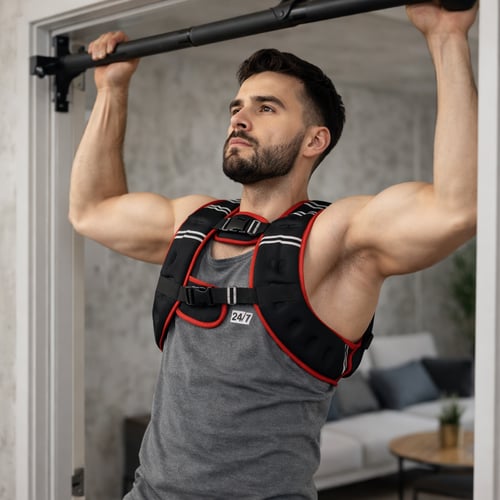
What a good fit feels like:
- Snug across the chest – close enough that jogging on the spot moves nothing
- Free breathing – a full breath feels completely normal, never restricted
- Arms unrestricted – swing, reach and press without the panel catching
- Balanced front to back – no sense of tipping forward while standing still
- Straps that stay put – nothing loosening off halfway through a session
- Fine at twenty minutes – the point where a bad fit always becomes obvious
Settling the fit before the kilos gets the order right. Fit decides whether the vest gets worn at all, while weight only decides how hard the session lands. Check the circumference first, then choose the load – the rest falls into place from there.
Adjustable or Fixed-Weight Vest – Which Makes More Sense?
A fixed load usually makes more sense for anyone training several times a week, since it never needs adjusting mid-session. On an adjustable weighted vest, the progression lives in the plates you add or remove. With a fixed load it lives in the session instead – nothing to load, nothing to lose, and the same feel every time it goes on.
That second route works better than most people expect. More minutes, a steeper hill, more reps, a quicker tempo – the session carries the progression until the panel itself feels light. Both of ours use the same double fastening and the same reflective strips, so the heavier model handles like the lighter one, with no clip or insert to work loose over time. Side by side, the practical differences come down to percentages and panel size.
Weighted Vest 5 kg
- Load on a 70 kg body: About 7%
- Who it suits: A first vest, walking, longer easy sessions
- Panel size: L 38 cm / W 34.5 cm
- Chest range: 80-114 cm
Weighted Vest 10 kg
- Load on a 70 kg body: About 14%
- Who it suits: Months of loaded work behind you, strength circuits
- Panel size: L 43 cm / W 37.5 cm
- Chest range: 80-114 cm
A 10kg weighted vest is a serious step up rather than a small upgrade – on a 70 kg body it is roughly double the load of the lighter panel. The Weighted Vest 10 kg uses a bigger panel, L 43 by W 37.5 cm, to spread that sand across more of the torso. That balance gets easier to judge with time.
Picking the Load That Keeps You Training
Start near 5% of body weight, spend the first weeks adding minutes rather than kilos, and treat any change in posture or stride as the signal to ease back. For most people that means a 5 kg panel through the early months and a heavier one later, with the fit checked properly before either goes near a hill. The load that works is the one you stop noticing halfway through the walk. When the lighter vest no longer feels challenging, our 10 kg version offers twice the load!
FAQ: Most Common Questions About Weighted Vest Weight
Is 10 kg Too Heavy for a First Vest?
Ten kilos is too much for most people starting out, since it lands near 14% of body weight at 70 kg and around 20% at 50 kg. It makes far more sense as a second vest, once loaded walks have been part of the week for months.
How Long Should the First Loaded Sessions Be?
Around ten minutes is enough to start, and a route you already know makes it easier to judge how the load sits. Add time before you add weight, and only once the walk with the vest starts to feel routine.
Can the Same Weight Work for Walking and Strength Work?
One vest usually covers both, because controlled squats and step-ups tolerate a load that would feel heavy on a long walk. If anything, the walking sessions are the ones that decide which panel you buy.
How Do You Know a Vest Is Too Heavy?
Watch the stride and the shoulders: a shortened step, a forward lean or a session that ends early all point to too much load. Persistent soreness the next day is an even clearer sign that the load is too heavy.
Author: Hop-Sport Team