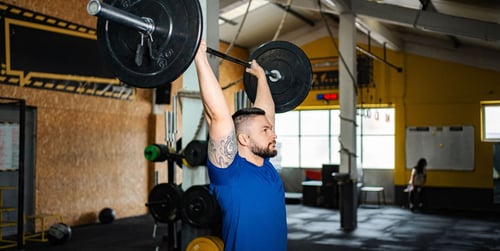
Unlock your true upper-body power with the barbell overhead press, a timeless compound lift that dominates strength training routines worldwide. Whether you're hoisting one of those trusty barbells for the first time or refining your technique, this exercise delivers unmatched gains in shoulder strength, core stability, and overall athletic prowess. Dive into this ultimate guide to master every rep with precision and confidence.
What is the barbell overhead press (OHP)?
The barbell overhead press (OHP) stands as a foundational compound exercise in strength training, involving the pressing of a barbell from shoulder height directly overhead while standing. You grip the barbell slightly wider than shoulder-width, unrack it from a weight rack, and drive it upward by extending your arms fully, engaging your shoulders, triceps, and core for stability. Then, you lower it in a controlled manner back to the starting position.
Why the barbell overhead press is essential for strength training
The barbell overhead press forms a cornerstone of effective strength training programmes due to its comprehensive engagement of multiple muscle groups and functional benefits.
This exercise delivers unparalleled development for the upper body while enhancing overall stability and power.
- Improves core strength and stability: Standing execution demands intense bracing to prevent arching or imbalance under heavy loads, building resilience throughout the kinetic chain from feet to hands.
- Enhances pressing power and performance: It boosts lockout strength and carries over directly to other lifts like the bench press or Olympic movements, allowing heavier loads overall.
- Promotes functional real-life strength: The overhead motion mirrors everyday tasks such as lifting objects high, fostering balance, injury prevention, and practical power.
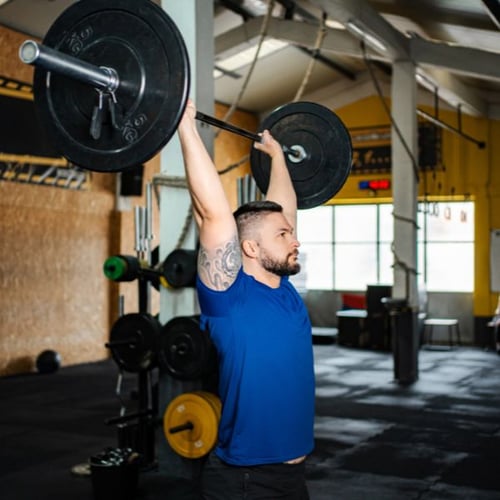
Incorporating the barbell overhead press into your routine equips you with the raw power and resilience needed for advanced strength gains.
Barbell overhead press: Muscles worked
The barbell overhead press activates a wide array of muscles across the upper body and core, making it a highly efficient compound movement for strength development. You engage both primary movers responsible for the pressing action and secondary stabilisers that ensure proper form and balance throughout the lift.
Primary muscles:
- Anterior deltoids: These drive the upward pressing motion, extending the shoulders as you push the barbell overhead.
- Triceps brachii: They extend the elbows fully during the lockout phase, providing the finishing power for each repetition.
- Upper chest (clavicular pectoralis major): This assists in initiating the press from the starting position at shoulder height.
Secondary muscles:
- Lateral and posterior deltoids: These stabilise the bar path and control the descent, contributing to balanced shoulder development.
- Trapezius and rhomboids: The upper and middle traps retract and elevate the shoulder blades for posture and scapular stability.
- Core muscles (abs, obliques, erector spinae): They brace isometrically to maintain an upright torso and prevent arching under load.
This comprehensive muscle recruitment underpins the exercise's effectiveness for building functional upper-body power.
How to do the overhead press with barbell properly
Mastering proper form in the barbell overhead press ensures maximum gains while minimising injury risk. Follow these guidelines to execute the lift effectively and safely.
Step-by-step guide to perfect form
Position yourself under the barbell in a squat rack at collarbone height, gripping it slightly wider than shoulder-width with wrists straight and elbows forward.
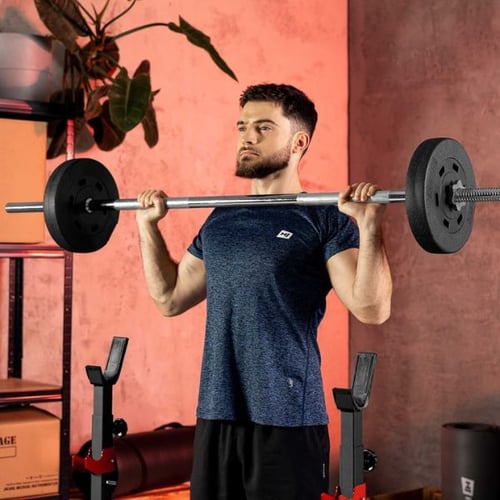
- Setup and unrack: Feet hip-width apart, brace your core, squeeze your glutes, and unrack the bar by straightening your legs while keeping it on your front delts with elbows high.
- Press phase: Take a small step back if needed, inhale deeply, then drive the bar straight up by pushing your head forward slightly and extending elbows fully to lockout overhead.
- Lower and repeat: Exhale as you lower the bar in a controlled manner to your shoulders in a straight path, maintaining tension without letting it rest until the set ends.
This sequence promotes smooth mechanics and power transfer for optimal results.
Common mistakes and how to fix them
Avoiding pitfalls elevates your performance and longevity in training.
- Leaning back excessively: This strains the lower back - fix it by strengthening your core and practising with lighter weights to maintain an upright torso.
- Flared elbows or jutting the head forward: These compromise shoulder safety - correct it by keeping elbows at 45-60 degree angle forward and tucking your chin on the ascent.
- Partial range or bouncing the bar: Incomplete reps limit gains - ensure full lockout and controlled descent every time without momentum from the rack.
Refining these aspects transforms your overhead press into a reliable strength builder.
Overhead press variations and progressions
Overhead press variations and progressions offer ways to target weaknesses, add variety, and drive continuous improvement in your strength training. Explore these options to keep your sessions dynamic and effective.
Standing overhead barbell press vs seated version
The standing barbell overhead press demands full-body stabilisation, making it superior for core engagement and functional strength. In contrast, the seated version isolates the upper body more by reducing lower-body involvement, which suits beginners or those addressing shoulder mobility issues.
Military press and push press explained
The military press emphasises strict form with no leg drive, honing pure upper-body power and control for advanced lifters. The push press introduces a controlled leg dip and explosive extension to handle heavier loads, bridging overhead pressing with power training.
Dumbbell vs barbell overhead press
Dumbbells allow a natural range of motion and independent arm work, correcting imbalances and enhancing stabilisation. Barbell presses enable heavier weights and symmetrical loading, prioritising raw strength gains through bilateral effort.
How to progress safely and avoid plateaus
Gradually increase weight by 2-5% weekly while prioritising form, then incorporate pauses or slower eccentrics when stalled.
- Deload periodically: Reduce volume or intensity every 4-6 weeks to recover and super compensate.
- Add accessory work: Strengthen with face pulls or lateral raises to support pressing power.
- Vary rep schemes: Cycle between 3-5 reps for strength and 8-12 for hypertrophy.
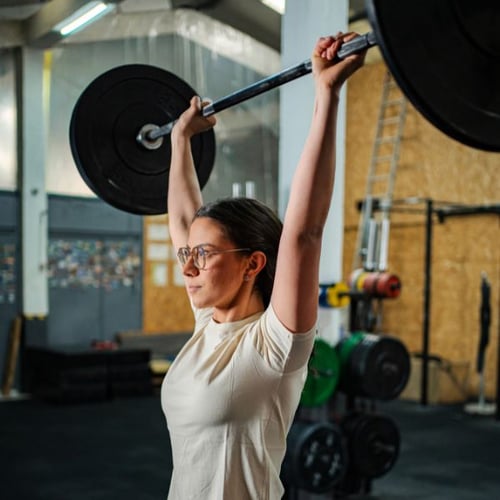
These strategies ensure sustained progress without burnout or injury.
Barbell overhead press FAQ
Common questions about the barbell overhead press reveal key insights for optimal execution and programming. Addressing these helps you integrate the lift confidently into your routine.
How much should beginners lift?
Start with empty Olympic barbells (typically 20 kg for men and 15 kg for women) or add small weight plates, prioritising flawless form over heavy weight to establish a strong technical base before progressing gradually with Olympic Weight Plate 2,5 kg increments each session.
Is barbell overhead press safe for shoulders?
Yes, it proves safe when you possess adequate shoulder mobility and maintain strict technique. Always perform dynamic warm-ups with light sets and band work, and consult a qualified trainer or physiotherapist if you experience impingements or pre-existing issues.
How often should I incorporate OHP into my training?
Train it 1-2 times per week within upper-body or push-focused sessions, ensuring 48-72 hours of recovery between sessions to allow muscle repair and super compensation for steady strength gains.
What if I lack a squat rack?
Opt for a power rack as a reliable alternative, or practise barbell cleans from the floor if your technique supports it. Master the clean first with lighter loads to prevent lower back strain from poor positioning.
Author: Hop-Sport Team