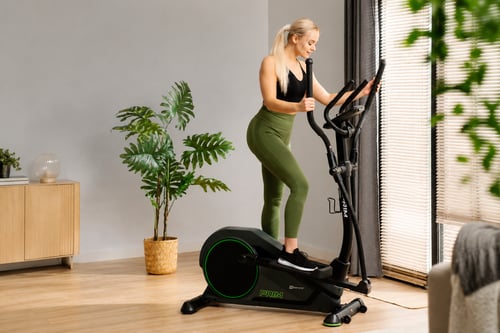
Standing in front of a cross trainer for the first time, most people climb straight on and start moving because the machine looks like it explains itself. Twenty minutes later the feet feel numb and it is hard to say whether that was training or fidgeting. Learning how to use a cross trainer is the work of one session, once somebody tells you where the feet, the shoulders, the hands and the resistance dial belong. Get them right today and every session after this one is easier to repeat!
Your first sessions, step by step:
- Feet flat, heels down – the whole sole stays on the platform, with a soft bend in the knees.
- Handles are a choice – moving bars for the arms, fixed bars for balance and a pulse reading.
- Two dials set the effort – resistance and cadence, whatever else the machine adjusts.
- The talk test beats the screen – full sentences mean the pace suits a beginner.
- Ten to twenty minutes – three to five times a week, adding time before load.
How to Use a Cross Trainer: What Is Elliptical Training?
Your soles stay on the platforms from the first stroke to the last, your legs follow the path those platforms set, and the weighted flywheel smooths the handover from one leg to the other. Two minutes of it and the pattern makes more sense in your legs than in any description.
What Does a Cross Trainer Do for Your Body?
Your breathing changes first, and that is the clearest sign of what a cross trainer does for your body. Your arms push and pull while your legs drive the pedals, so a lot of muscle works at once and the heart has to supply all of it. It is steady aerobic exercise with almost no impact travelling up through the ankles and knees, because the foot never lands.
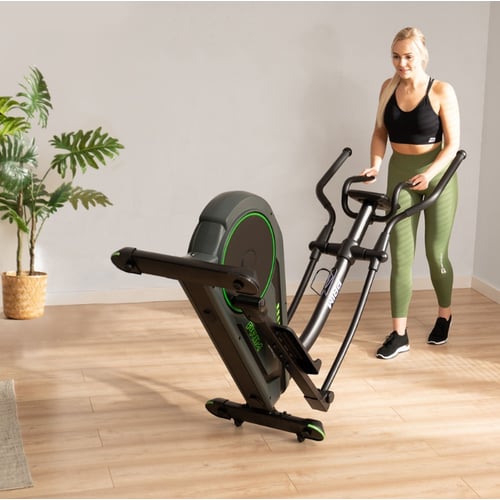
The rest of the benefits of cross trainer work come from how repeatable it is: an even stride, no weather and a load you set yourself. When people ask us for a machine that keeps things simple, we point them to the Magnetic Elliptical Trainer HS-003C Focus – Gold: the load sits on a knob on the frame, and the pulse sensors are in the stationary handlebars.
Getting On and Off a Cross Trainer Safely
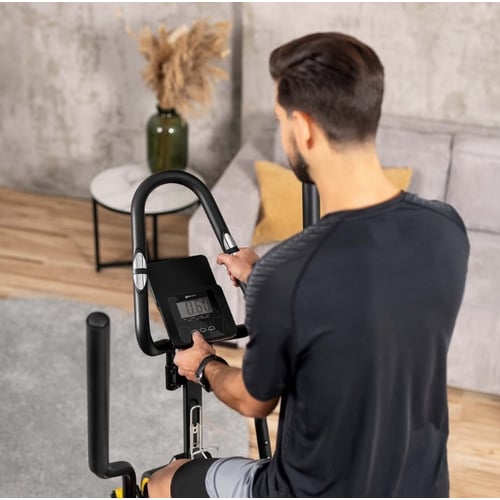
Mount from the side, where the frame gives you something solid to hold. Take the fixed bar with one hand, step onto the pedal sitting lowest, then bring the second foot across and let the platforms move under you. Coming off is the part people misjudge: let the pedals slow to a stop first, keep a hand on the bar and step backwards off the deck. On any elliptical exercise machine the flywheel carries momentum for a few seconds after your legs stop.
Quick tip: if you need to stop in a hurry, put both hands on the fixed bars and let your legs slow the pedals down before you step off.
How to Use a Cross Trainer: Correct Foot Placement and Posture
Put the whole sole on the platform and keep your heels down. If the heels lift on every stroke you are pushing through the toes, and ten minutes of that arrives as pins and needles in the forefoot. Set the feet roughly hip width apart, pointing forwards, then shuffle them while you pedal until nothing pinches.
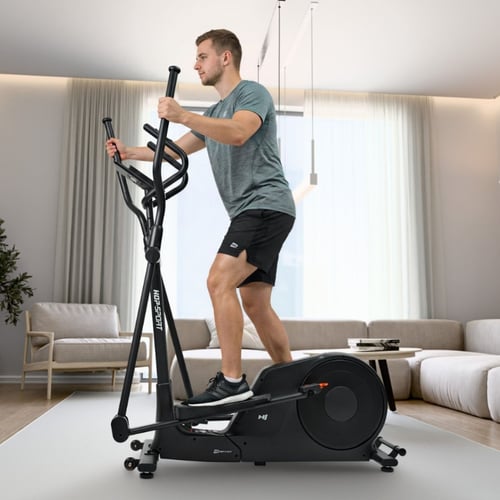
Then stand tall. Ribs stay stacked over your hips, shoulders stay down and back, and your eyes look ahead at the wall. Leaning your weight onto the handlebars pushes it into your wrists and takes the work off the legs, which is the usual reason a session feels easy and achieves little.
Four posture habits worth breaking early:
- Locked knees – a soft bend absorbs the stride, straight legs pass all of it into the joint.
- Lifting heels – usually a sign the pace has run ahead of the resistance.
- Hunched shoulders – follows from gripping the moving bars harder than you need to.
- Bouncing hips – the load is too light for the speed you are holding.
Every few minutes, run a check from the ground up: heels, knees, hips, shoulders. Posture drifts as you get tired, and it drifts in the same order every time.
How to Use the Handles for a Full Body Workout
Take the moving bars and the arms join the stride, which is what makes this a full body workout and why your effort climbs faster here than on a bike. Push with one arm as the opposite leg drives forward, in the diagonal rhythm walking gives you. The fixed bars have other jobs: hold them while you learn the stride, when you reach for a drink, or when you take a reading from the sensors. Swapping every few minutes is a good way to organise a session.
How to Use Resistance Levels on Cross Trainer Machines
Set the load so your legs meet something to push against while the pedals still turn smoothly. Too light and the flywheel drags you around; too heavy and the stride shortens until your cadence collapses. Cross trainer machines vary here, but on magnetic elliptical cross trainers the resistance sits on a dial you turn by hand, so the first skill is learning what one step up feels like.
How to find your starting level:
- Begin two levels low – the dial goes up easily once the stride has settled.
- Legs meet the load – there is push-back under the foot without the pedals fighting you.
- Hips stay level – rocking from side to side means the setting is too light for your speed.
- Cadence holds – a stride that shortens and slows is a level too far.
- Note where you finish – start the next session on that level.
Change the setting during the session as well: two easy minutes to begin, a level higher for the main block, then back down for the finish.
How to Adjust Incline and Stride Length
Some machines let you raise the ramp or change how long the stride is; plenty of others do not. Where an incline setting exists, it raises the stride and moves more work into the hips and the back of the legs. Where the stride can be changed, a longer path suits taller users and a shorter one keeps the movement compact. Both are normally set before the session.
Plenty of home machines have a fixed stride and a fixed angle, and that takes nothing away from what a session can do. The effort still comes from two dials you always have – resistance and cadence – plus a third one people forget, which is your own position. Standing tall with hands off the bars loads the legs differently from leaning forward with the arms working.
How to Set Your Pace: Finding the Right Rhythm
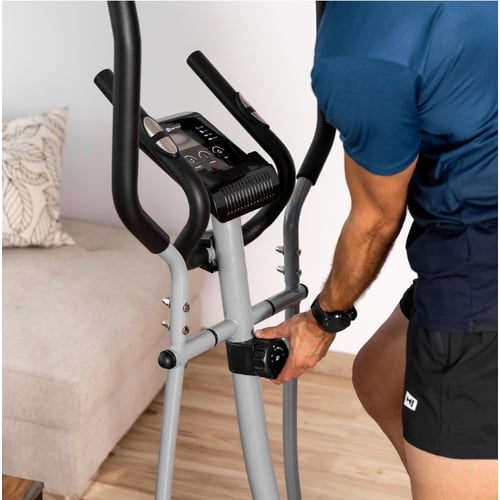
Aim for a pace you could hold for the whole session, then check it by talking. If you can speak in full sentences, you are in the moderate range that NHS guidance points beginners towards. If you manage only a few words between breaths, you have moved into vigorous work, which is useful in short blocks and exhausting as a default.
Smoothness tells you as much as speed does. Quiet platforms, level hips and a loose grip on the bars are the signs that the rhythm suits you. If the pedals feel like they are running away, add resistance; if your legs burn while your breathing stays easy, take a level off and lift the tempo instead. General fitness comes from a smooth stride you can repeat week after week. A pace you abandon at minute eight adds nothing.
How to Use a Cross Trainer for Weight Loss and a Calorie Deficit
How the rest of your week looks matters more than the machine: a cross trainer is good for weight loss only inside a calorie deficit, and no machine creates one by itself. What this one does well is hand you repeatable minutes: gentle on the joints and easy to slot into an evening.
A simple way to build a weekly cross trainer workout plan:
- Start with frequency – three sessions you will actually do beat five on paper.
- Add minutes first – roughly ten per cent more each week keeps the progression gentle.
- Then add resistance – once the time feels comfortable, raise the load before the pace.
The other half of the week happens away from the machine. Walking while you work adds movement that never feels like training, and our Walking Pad HS-650WP Revo runs from 1 to 6 km/h and stands 11 cm high, so it slides under a desk on days when a full session is not happening.
How to Use Heart Rate Zones During Your Workout
Zones are a way of labelling effort with numbers. Moderate work sits at roughly 50 to 70 per cent of your maximum heart rate, vigorous work above that, and the common estimate of the maximum is 220 minus your age. Treat that as a starting scale; it can be out by a wide margin. Grip sensors in the fixed handlebars give you an estimate, useful for comparing one session with the next. Training by zones properly is easier with a chest strap; training by feel works just as well with the talk test.
How Long Should You Use a Cross Trainer Each Session?
10-20 minutes is plenty for the first few weeks, 3-5 times a week. That is short enough to finish comfortably and frequent enough for the movement to become familiar. Extend the session before you extend the effort: 20 minutes becomes 25, then 30, while the resistance stays where it is.
Legs that ache a day after your first sessions are responding to a new movement pattern, and the ache fades as the pattern stops being new. On those days a shorter, easier spin often feels better than sitting still. Once thirty minutes feels routine, play with how you spend the time: steady blocks, a harder middle, an easy finish.
Your First Month on the Cross Trainer Runs on Repetition
Almost nothing in the first month depends on how hard you push. It depends on whether the session happens at all: shoes on, twenty minutes, feet flat, shoulders down, resistance where your legs meet it. Small details are what make those sessions repeatable. Our magnetic cross trainer sets its resistance with a hand knob and reads your pulse straight from the fixed handlebars, so starting tomorrow takes one turn of a dial.
FAQ: Most Common Questions About Using a Cross Trainer
Does Pedalling Backwards Make a Difference?
It makes enough of a difference to be worth a minute or two, once your forward stride is steady. Slow the pedals almost to a stop before you change direction, keep both hands on the fixed bars and your heels down for the first few strokes, and go back to pedalling forwards for the rest of the session.
Can You Use a Cross Trainer Every Day?
Daily use is fine when most of those sessions stay short and easy, since the stride is gentle on the joints. Alternate a harder day with a relaxed one, and drop a level whenever yesterday's session is still in your legs.
Why Do the Calories on the Console Look So High?
The calorie figure is an estimate calculated from time, speed and resistance, and the console knows nothing about your weight or how efficiently you move. Use it to compare your own sessions with each other, and keep it out of any calculations about food.
Does the Machine Need to Sit Level?
A cross trainer works best on a flat, firm floor, and the levelling feet on the frame take out the last few millimetres of wobble. A frame that rocks under load feels unsteady at speed and gets noisy, so it is worth two minutes of adjustment on day one.
Author: Hop-Sport Team