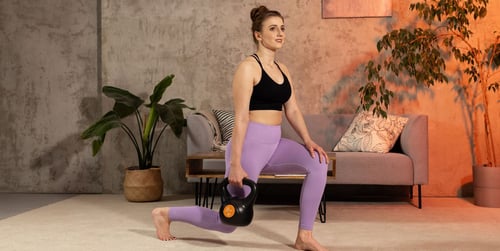
Imagine transforming your fitness routine with a single piece of equipment that delivers explosive power, sculpts lean muscle, and torches fat - all in one dynamic session. Training with kettlebells stands out for its ability to engage your entire body through multi-joint movements, building the functional strength you need for peak performance and everyday resilience. Explore 9 key kettlebell exercises to unlock your full potential and elevate your workouts today.
What is a kettlebell?
A kettlebell is a specialised free weight consisting of a compact, usually cast-iron or steel ball with an integrated handle, giving it the appearance of a cannonball with a handle. Its distinctive design shifts the centre of mass away from the hand, which differentiates it from dumbbells and allows for dynamic, swinging and ballistic movements as well as traditional strength training.
This unique load placement challenges grip, core stability, coordination and cardiovascular capacity simultaneously, making the kettlebell a highly efficient tool for developing functional strength, power and endurance across the whole body.
Best kettlebell exercises: Our top 9
When chosen and executed with care, kettlebell exercises for beginners can offer a highly efficient way to build strength, mobility, and cardiovascular fitness within a relatively short session. The following movements represent a balanced selection that challenges the whole body, supports long-term joint health, and can be adapted to a wide range of training levels.
Kettlebell swing
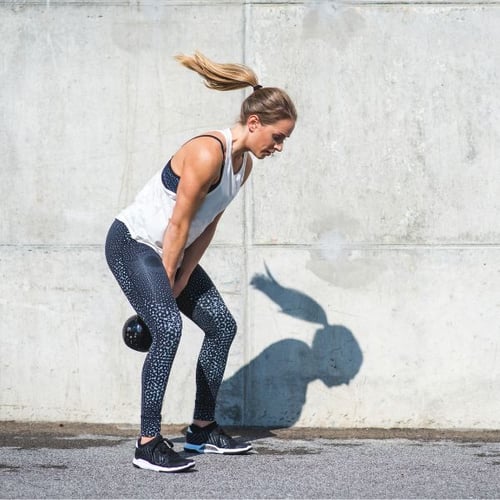
The kettlebell swing is a cornerstone exercise for developing powerful hips and a robust posterior chain, particularly the glutes and hamstrings. It relies on a strong hip hinge rather than a squat, generating force from the hips while maintaining a neutral spine and braced core. By elevating heart rate and engaging large muscle groups, it delivers strength and conditioning benefits, improving power, posture, and daily resilience with sound technique.
Execution:
Position the kettlebell slightly in front, feet shoulder-width apart, toes slightly out. Hinge at the hips, grip the handle with both hands, tilt the bell towards you, hike back between legs. Drive feet into floor, snap hips forward to float bell to chest height (arms relaxed, chest open, spine neutral). Hinge back and repeat rhythmically without squatting.
Kettlebell clean and press
The kettlebell clean and press combines explosiveness with overhead strength, building coordination, shoulder stability, and core tension. The clean lifts the bell from the floor to rack position, while the press drives it vertically close to the body. This full-body exercise strengthens hips, back, shoulders, and grip - ideal for home strength training.
Execution:
Position the kettlebell between your feet in a hip hinge stance, back straight, core braced. Hike the bell between your legs, explosively extend your hips – rotate your hand to rack (wrist straight, elbow tucked). Press overhead with tight core, lower controllably
Kettlebell Turkish Get Up (TGU)
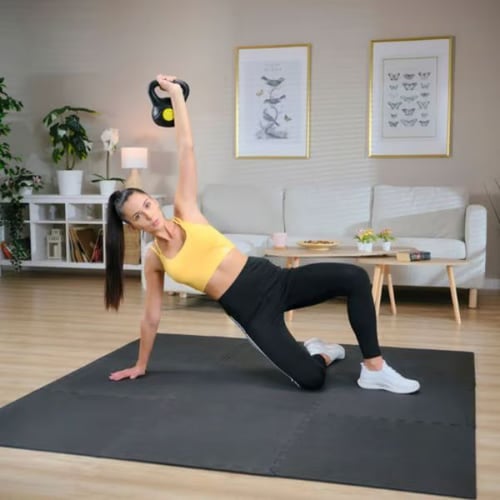
The Turkish Get Up is a highly technical, multi-stage movement that builds full-body stability, mobility, and awareness. It transitions you from lying on the floor to standing and back while keeping a kettlebell locked overhead, requiring precise control at every phase. Challenging the shoulders, core, and hips simultaneously, the TGU enhances joint integrity and functional strength, with consistent practice building confidence under load.
Execution:
Lie on your back with the kettlebell beside you, roll to grip the handle with both hands, then back with the bell overhead, arm straight. Bend the same-side knee, place the opposite arm at 45 degrees, eyes on the bell. Drive through the foot to rise to the elbow then hand, lift the hips, sweep the leg into a half-kneeling position, then stand tall. Reverse with control, keeping the shoulder stable.
Kettlebell halo
The kettlebell halo is one of the best kettlebell exercises for abs, warm-ups and active recovery, as it promotes shoulder mobility and postural control without excessive load, helping to prepare the upper body for pressing and overhead work.
Execution:
Stand tall or in a half-kneeling stance, holding the kettlebell upside down by the horns at chest height with the core braced. Bring one hand slightly higher and guide the bell around the side of your head, behind it, and to the other side in a smooth circle, keeping it close but not touching and avoiding any leaning or twisting of the spine. Perform several controlled circles in one direction, then repeat in the opposite direction, maintaining fluid, pain-free shoulder movement.
Goblet squat with kettlebell
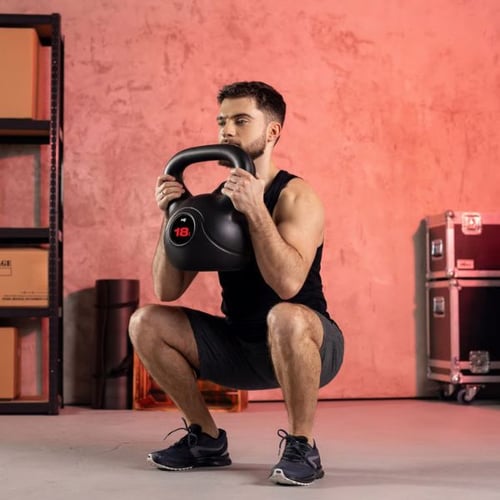
The kettlebell goblet squat offers an accessible way to refine squatting mechanics and develop lower-body strength. Holding the kettlebell close to the chest encourages an upright torso for deeper squats with improved balance and alignment. It targets the quads, glutes, and core while enhancing hip and ankle mobility, serving as a safer alternative to barbell squats for technique-focused training.
Execution:
Stand with feet shoulder-width apart, toes slightly out, kettlebell held by the horns at chest level, elbows down. Brace core, lift chest, and squat by bending hips and knees, sitting between heels to parallel depth. Keep heels down, knees over toes; drive through mid-foot and heels to stand, keeping the kettlebell close and the torso upright.
Kettlebell snatch
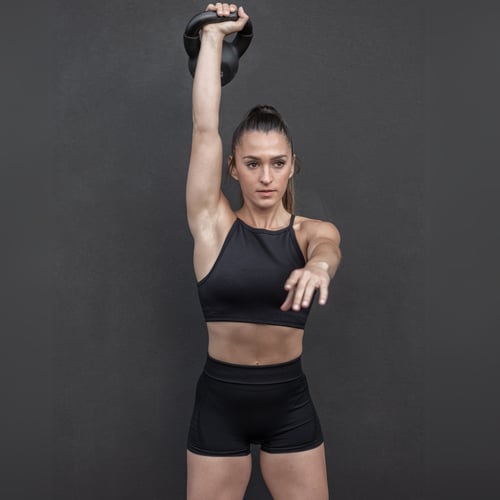
The kettlebell snatch is an advanced ballistic lift that moves the bell from a swing or hang directly to an overhead lockout in one fluid action. It builds hip power, shoulder endurance, grip strength, and cardiovascular capacity, making it highly effective for short, intensive conditioning sessions.
Execution:
Set up in a strong hip hinge with the kettlebell on the floor slightly in front of you and feet about hip‑width apart. Grip the handle with one hand, hike the bell back between your legs, then extend the hips and knees explosively so it travels upwards close to your body. As it passes chest height, allow a slight elbow bend and “punch” your hand through the handle so the bell rotates softly onto the back of the wrist into a stable overhead position, with the arm locked out and the shoulder stacked. Either guide the bell down along the same path or let it drop into a controlled swing to begin the next repetition.
Kettlebell row / gorilla row
The kettlebell row, also known as the gorilla row, is a dynamic pulling exercise that builds back strength, grip endurance, and core stability through a powerful hip-driven row from a staggered stance.
Execution:
Adopt a staggered stance with one foot forward and the kettlebell on the floor beside the front foot, hinge at the hips with a flat back and braced core. Grip the handle with the hand on the same side as the front foot, then explosively drive your hips forward while pulling the bell in a straight line to your lower ribs, keeping the elbow tight to your body. Squeeze your back at the top, lower under control to the floor, then switch sides or repeat for reps. For gorilla row variation, alternate sides in a fluid athletic stance without pausing.
Kettlebell windmill
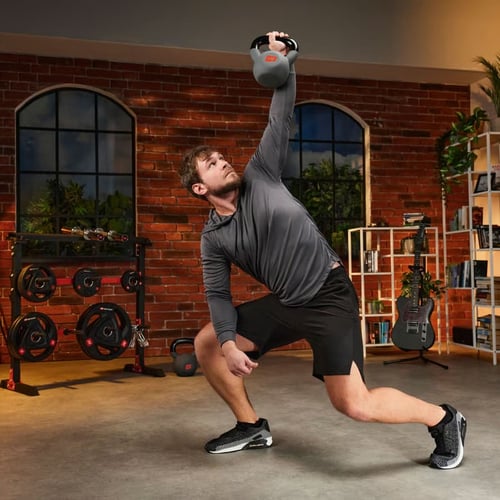
The windmill is one of the greatest kettlebell core exercises which additionaly builds shoulder stability and hip mobility through a controlled hinge and rotation under load. It enhances flexibility, balance, and oblique control while decompressing the spine.
Execution:
Hold the kettlebell overhead with one arm locked out, feet pointed away at 45 degrees. Hinge at the hips, slide the free hand down the leg towards the floor while keeping eyes on the bell and core braced. Return smoothly to standing, switch sides.
Why kettlebell exercises are the perfect choice for home workouts
Kettlebell moves are a highly efficient option for home-based training. A single pair of appropriately selected kettlebells is enough to support progressive programming without requiring extensive gym infrastructure.
- Compact and versatile design: Kettlebells offer superior portability compared to cumbersome machines or barbells and racks, enabling multi-joint movements such as squats, swings, presses, and carries that engage multiple muscle groups concurrently.
- Scalable progression: Intensity can be precisely adjusted through load selection, repetition tempo, or set duration, accommodating beginners through to advanced athletes within the same implement.
- Functional and integrated conditioning: These movements replicate fundamental movement patterns like lifting, hinging, and carrying, fostering transferable strength while simultaneously elevating heart rate for concurrent strength and aerobic development.
Integrating kettlebells into a home regimen yields time-efficient outcomes that enhance both athletic performance and functional capacity for daily demands.
Explore this topic: Kettlebell vs Dumbbell: Key Differences, Benefits & Which One You Should Choose
Author: Hop-Sport Team