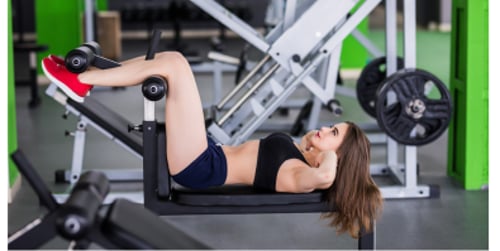
You don’t need a full gym membership to build strength, tone your muscles, and feel fitter. With just weight benches and a pair of dumbbells, you can perform dozens of effective weight bench exercises that target every major muscle group - all from the comfort of your home. Whether you’re short on time, space, or motivation, your weight bench can become a mini home gym that helps you stay consistent and see results.
Why weight bench exercises are perfect for home workouts
Weight bench exercises represent an optimal choice for home-based strength training, offering exceptional versatility, stability, and efficiency within constrained spaces. This equipment empowers you to achieve comprehensive full-body development without the need for extensive gym facilities or travel.
A quality weight bench facilitates a broad spectrum of compound and isolation movements, enabling targeted muscle engagement across the upper and lower body while promoting progressive overload for sustained gains. The biggest benefits are:
- unparalleled versatility in compact form: Adjustable inclines and declines support exercises, allowing precise targeting of the muscles, all from one space-efficient unit that integrates seamlessly into any home environment;
- enhanced stability, form, and injury prevention: The robust, padded surface provides superior support for heavy lifts like rows and hip thrusts, ensuring optimal spinal alignment and joint protection, which surpasses the limitations of floor-based alternatives;
- convenience fostering long-term adherence: Eliminate gym commutes to enable frequent, flexible sessions around your schedule; many models feature foldable designs for effortless storage, maximising usability in domestic settings.
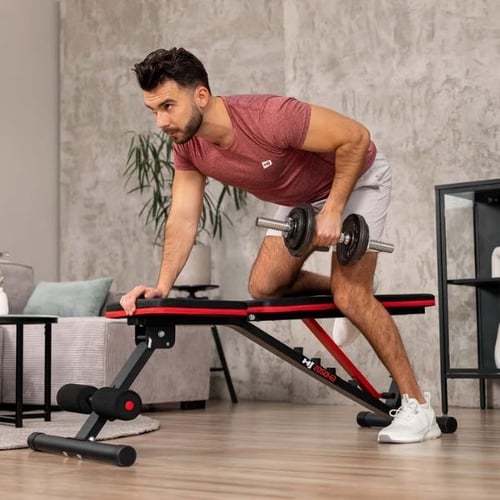
By incorporating a weight bench into your routine, you establish a professional-grade home training station that delivers measurable improvements in strength, posture, and overall fitness resilience.
Getting started with bench weight exercises
Start your bench weight exercise programme with a sturdy, adjustable bench and suitable free weights like dumbbells or a barbell, laying a safe foundation for effective home strength training. Focus from day one on mastering correct posture and movement patterns to maximise gains while protecting against injury.
Adopt a structured approach that prioritises gradual progression and full-body engagement for well-rounded development.
- Choose the right equipment: Opt for a durable bench with adjustable inclines and a high weight capacity, paired with manageable loads that let you perfect technique before advancing.
- Perfect your setup and form: Secure your feet, keep a neutral spine, and emphasise controlled lowering phases to enhance stability and avoid pitfalls like unnecessary joint stress.
- Build balanced routines: Select 3-4 exercises per session, mixing upper and lower body work across 3 sets of 8-12 reps to drive muscle growth, endurance, and lasting results.
This methodical method ensures enjoyable, sustainable progress.
Best weight bench exercises for beginners
Beginner-friendly weight bench exercises provide an accessible entry into strength training, leveraging the bench's stability to target key muscle groups safely at home. These movements build foundational strength, improve form, and support progressive overload without overwhelming complexity.
1. Flat bench press - classic bench exercise for strength

The dumbbell bench press serves as a cornerstone compound exercise that primarily strengthens the chest, shoulders, and triceps while engaging the core for stability.
Lie flat on the bench with feet planted firmly, grip the barbell or dumbbells at shoulder width, lower the weight controlled to chest level, then press explosively upwards driving through your heels. Maintain a slight arch in your back and elbows at 45 degrees to maximise power and minimise shoulder strain..
2. Seated shoulder press - essential bench and weight exercise
The seated shoulder press builds robust deltoids and upper-body pressing power, with the bench providing essential back support.
Sit upright on the bench with dumbbells at shoulder height, palms forward, press them overhead until arms are nearly straight, then lower in a controlled manner to the starting position. Engage your core to prevent arching and keep elbows slightly forward.
3. Bench dips - triceps bench workout
Bench triceps dips effectively target the triceps while secondarily working the chest and shoulders in a bodyweight format.
Sit on the bench edge, hands beside hips, lift your glutes off and walk your feet forward, lower your body by bending elbows to 90 degrees, then press back up. Keep shoulders retracted and avoid shrugging. Aim for 3 sets of 10-15 reps to sculpt arms without equipment overload.

4. Bulgarian split squat - powerful weight bench leg exercise
This rear-foot elevated split squat intensifies quad, glute, and hamstring engagement for superior leg development.
Place one foot behind you on the bench, hold dumbbells at sides, lower into a lunge until the front thigh is parallel to the floor, then push up through your front heel. Maintain an upright torso and equal depth on both sides.
5. Hip thrust - glute activation on the weight bench
Hip thrusts rank among the most effective bench-based exercises for building strong, sculpted glutes, targeting the posterior chain with precision and power. This movement enhances hip extension, boosts athletic performance, and counters sedentary lifestyles by fortifying the glutes, hamstrings, and lower back.
Position your upper back against the bench edge with shoulders supported, feet flat on the floor hip-width apart, and a barbell or dumbbells across your hips. Drive through your heels to lift your hips until your body forms a straight line from knees to shoulders. Squeeze your glutes at the top for peak contraction, then lower controlled without resting fully.
6. Decline sit-ups - targeted weight bench exercise for abs

Decline sit-ups intensify core training by increasing resistance on the upper abs and hip flexors.
Secure feet under the bench's incline roller, cross your arms over chest, curl your torso up towards knees, then lower slowly with control. Exhale on the ascent and avoid pulling with your neck.
7. Reverse hyperextension - strengthen glutes and lower back
This posterior chain exercise fortifies glutes, hamstrings, and lower back, countering desk-bound postures.
Lie face down across the bench with hips at the edge, legs hanging off, lift them upwards by squeezing glutes until parallel to the floor, then lower controlled. Focus on the glute contraction and maintain a neutral spine.
Weight bench exercises for women
Weight bench exercises suit women and men equally well, with no movements designed exclusively for one gender. All the exercises detailed earlier deliver universal benefits in building strength, enhancing muscle tone, and improving functional fitness, simply adapted to individual goals and experience levels.
These routines excel particularly for women by targeting glutes and core stability, which support posture, bone density, pelvic floor strength, and metabolic health through progressive resistance. Women can progress safely with lighter loads and higher repetitions, focusing on impeccable form to achieve a lean, athletic physique without unnecessary bulk. This approach fosters confidence and sustainable results in a home setting, empowering long-term adherence to strength training.
Weight bench workout FAQ
Addressing common queries about weight bench workouts equips you with the knowledge to refine your home training for optimal safety and performance.
What is the ideal frequency for bench workouts?
Perform sessions 3-4 times per week, incorporating 48 hours of recovery between those targeting similar muscle groups to facilitate adaptation and prevent fatigue.
How do I progress safely in the bench exercises?
Increase resistance or repetitions by 5-10% weekly once form remains consistent, always prioritising controlled tempo over maximal loads for sustainable development.
What warm-up should precede bench sessions?
Begin with 5-10 minutes of light cardio followed by dynamic stretches and 1-2 lighter sets of your first exercise to enhance blood flow and neural activation.
Is spotting necessary for home bench presses?
This depends on your setup: spotting becomes essential if using a barbell for personal record attempts with heavy loads. In typical home conditions with dumbbells or weight racks, however, it proves unnecessary if you opt for conservative weights to retain full control.
Master these principles to elevate your bench training from routine to results-driven practice.
Author: Hop-Sport Team