
The best cardio machine is the one you get on at nine on a Wednesday evening, when you don't feel like anything at all. That is exactly where an exercise bike wins: no preparation, no trip across town, just a few steps across the room. Is that enough to lose weight and build fitness? The bike supplies the aerobic work and lets you repeat it week after week – and repetition is what decides the results. See how to fit it into your week!
What the bike really does for your training:
- Aerobic work you can repeat – no dry pavement or daylight required
- Resistance runs the session – 30 minutes can be recovery or your hardest ride
- Legs lead, trunk steadies – quads, hamstrings, glutes and calves share the work
- Fat loss stays whole-body – no machine chooses the spot it comes from
How Do Exercise Bikes Work?
Every ride comes down to one exchange: your legs turn a flywheel, and a resistance system decides how much effort each turn takes. A mechanical model presses a pad against the wheel; a magnetic one moves magnets closer without touching it, which keeps a magnetic stationary bike quiet enough for a flat with thin walls. The exercise bikes built for home training use both systems.
How do exercise bikes work once the wheels are turning? Resistance and cadence (the speed your legs come round) decide the rest. The pedals guide each leg along a fixed circular path, with no landing phase of the kind running involves, so the movement is easy to control. Across our range, that adjustment comes from a manual dial or from levels set on the console.
Three things change the effort on any bike:
- Resistance level – how hard the flywheel is to turn
- Cadence – how quickly each revolution comes round
- Time in the saddle – how long you hold that combination
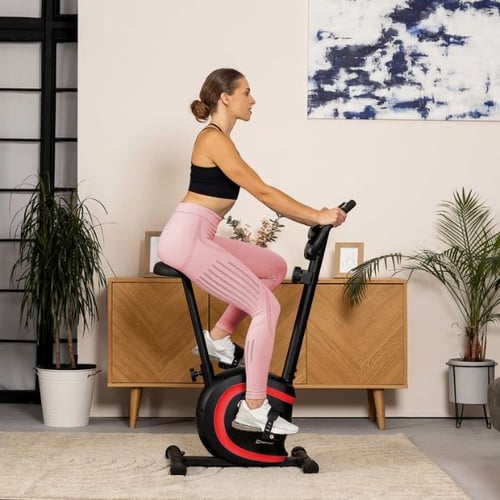
That predictability is the quiet advantage of a static bike – change one thing and you feel exactly what it did.
What Are Exercise Bikes Good For?
Three jobs, mainly: building aerobic capacity, adding training volume you can repeat, and giving you a session that ignores rain and traffic. Indoor cycling also hands you control that riding outdoors rarely offers – no junctions, no lights, no free-wheeling downhill. Are exercise bikes good for you as your only piece of kit? They cover the aerobic half of general activity advice, around 150 minutes of moderate work a week; the other half still calls for a couple of strength sessions.
Do Exercise Bikes Help You Lose Weight? The Science of Burning Calories
Cycling supports fat loss because it adds energy you would not otherwise spend, and most people can repeat it two or three times a week. Are exercise bikes good for losing weight on their own? They contribute, and the effect grows with total weekly minutes, not with one very long session. A console calorie figure is an estimate – it shifts with body mass, resistance, pace and time in the saddle.
What decides whether the weight actually moves:
- Weekly minutes – regular rides beat one occasional long session
- Effort mix – some easy riding, some genuinely firm efforts
- Food – training creates a calorie deficit, and your diet decides whether it lasts
- Sleep – it decides how well you recover and how hungry you feel
- Patience – changes show in body measurements before they show on the scale
Fat also comes off the whole body rather than from the muscles doing the work, so no ride picks an area for you. Progress shows on several fronts at once, even in weeks when the scale does not move.
Are Exercise Bikes Good for Cardio and Boosting Your Heart Rate?
Cardio is where the bike does its most obvious work: effort climbs within a minute and stays wherever you set it. Are exercise bikes good for cardio next to other machines? They train the same system through a different movement pattern, seated and continuous, so effort is easy to hold steady and to raise in small steps. Tactile sensors in the handlebars give a guide reading for heart rate when both palms rest on the grips.
Steady riding and interval work both improve your cardiovascular system, and neither wins in every situation: intervals pack more stimulus into less time, longer easy rides are simpler to recover from. Quick tip – at moderate intensity, you should be able to talk but not sing.
What Muscles Do Exercise Bikes Work During a Workout?
The quadriceps and hamstrings do most of the pushing and pulling, the glutes join in as resistance climbs, and the calves pass force through the pedal. Ask what muscles do exercise bikes work beyond those, and the answer is modest: the trunk and arms mainly stabilise, so the bike is mainly a lower-body cardio tool, with other muscles playing a supporting role.
The main contributors during a ride:
- Quadriceps – drive the pedal through the strongest part of the stroke
- Hamstrings – help bring it back round
- Glutes – contribute more as resistance and position change
- Calves – steady the ankle and finish the stroke
Saddle height changes how much the calves contribute, so a five-minute set-up is worth the time. A long workout leaves the legs pleasantly tired, though it is no substitute for lifting.
Choosing an Exercise Bike That Matches Your Sessions
Start with the room rather than the spec sheet. Measure the floor space you can give up permanently, then the space you can borrow for half an hour – that answer removes half the shortlist. A spin bike (a spinning bike, if you have seen the class advertised) carries a heavier flywheel and a forward position for standing efforts, while an upright frame keeps the footprint smaller.
Folding Convenience or Everyday Stability?
When the bike has to disappear between sessions, folding matters more than any other feature. Our Folding Magnetic X-Bike HS-3030X Apeks does exactly that: magnetic resistance set manually across 10 levels, transport rollers, and a footprint of 101 × 52 × 114 cm. Its maximum user weight is 120 kg.
Riding most days, or sharing the machine with someone heavier, pushes the priorities towards stability and finer control of the load. We stock the Electro Magnetic Exercise Bike HS-090H Apollo for that, with resistance set electronically across 32 levels and dimensions of 111 × 55 × 148 cm. Its maximum user weight of 150 kg is an equipment limit to respect, and levelling feet keep the frame steady on an uneven floor.
How to Plan an Effective Indoor Cycling Workout
Three modest sessions a week do more than one exhausting ride followed by five days of avoiding the machine. Give each ride a purpose before you sit down: one for easy volume, one for controlled discomfort, one for whatever the week allows. An indoor bike you walk past every morning gets used far more than a better one hidden away.
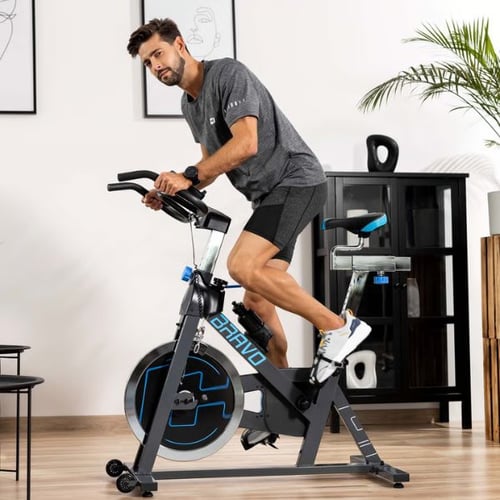
A straightforward week on the bike could look like this:
- Easy ride – 30 minutes at a pace you could hold while chatting
- Tempo block – 10 minutes warming up, 15 firm but controlled, 5 easy
- Intervals – six efforts of a minute, each with a minute of easy pedalling
- Recovery spin – 15 to 20 minutes on low resistance after a hard day
- One progression – add time or resistance weekly, never both at once
Warm up for five minutes before anything hard and give yourself the same at the end. Note the resistance level and duration afterwards – that record turns “I think it felt harder” into something you can repeat.
Where an Exercise Bike Fits Into Your Week
What it does is make the aerobic half easy to keep going on days when the weather would otherwise stop you from training. Ridden three times a week with honest effort, it improves how you breathe, how quickly you recover and, alongside sensible eating, how your clothes fit. Plenty of machines promise a transformation; ours simply make the next ride convenient enough that you take it – choose the one that fits your weekly routine and the space you have!
FAQ: Most Common Questions About Exercise Bikes
How Long Should a Beginner Ride For?
Fifteen to twenty minutes at an easy pace makes a sensible first session, two or three times in the opening week. Add five minutes at a time once the ride starts to feel routine.
Is an Exercise Bike Enough on Its Own?
The bike covers the aerobic side of a balanced week comfortably, which for most people is the harder half to keep going. Add two strength sessions, with weights or bodyweight, and the picture is complete.
How Accurate Are the Calorie Numbers on the Console?
Console figures are estimates built on general assumptions rather than measurements of your metabolism, so they suit comparing your own sessions. The trend across a month tells you more than any single readout.
Which Resistance System Should I Choose?
Magnetic resistance is quiet and easy to fine-tune, which suits early mornings and anyone who likes repeating an exact effort. Mechanical systems are simpler and perfectly capable for steady riding, so the choice comes down to how quiet and precise the bike needs to be.
Author: Hop-Sport Team