
Choosing a punching bag starts with two questions: what do you want to train, and where will the bag stand? The different types of punching bags answer those questions in very different ways – some build heavy punching power, others sharpen speed and timing, and the mounting decides which of them your home can handle. This guide covers eight types, from classic hanging bags to free-standing models with a weighted base, and helps you match one to your training and your space. Read on before you pick yours!
Bag by bag, the short version:
- Mounting first – a ceiling fixing, a wall bracket or a weighted base sets the shortlist
- Shape follows the strikes – long targets take low kicks, rounded ones open angles for hooks
- Filling varies – buffers, foam, air or water inside the target, sand or water in a base
- Hop-Sport's two models – free-standing bags of 170 and 180 cm, weighted at the floor, not overhead
How to Choose a Boxing Bag for Your Training Style
Start with the strikes you want to practise, not with the bag that looks best in photos. Then comes the question of how the bag stays in place: a fixing overhead, a bracket on a wall, or a weighted base on the floor. Most home setups land in the last group, which is why the punching bags aimed at flats are built around a base you fill yourself.
Run through four points before you commit to anything:
- Strike range – hands only, or hands plus knees and kicks at several heights
- Clearance – a swinging target needs space all round, a standing one a clear circle
- Floor and fixing – solid joists and a rated bracket, or an even, non-slip surface
- Session type – short power rounds, technical drills, or something the household shares
A boxing bag for pure handwork can be shorter and narrower than one built for kicks. Punching at chest and head height needs a fraction of the room that full-height kicks demand. An outdoor punch bag is a separate matter: it requires an explicit weather rating, because rain and UV quickly damage ordinary covers.
What Are Punching Bags Filled With?
There is no single filling, and that is the honest answer to what are punching bags filled with. Textile offcuts and fabric buffers are the common choice at home, foam turns up in softer targets, and some designs use air or water. Boxing bags meant for hard power work tend to be denser.
Base ballast is a separate story. A standing model is usually filled with water or sand at the bottom, which has nothing to do with what sits inside the target you hit – confusing the two is where the common myth about sand-filled bags comes from. The filling should also settle evenly because hard spots quickly lead to sore wrists.
Free-Standing Punch Bag: A Practical Option for Home Workouts
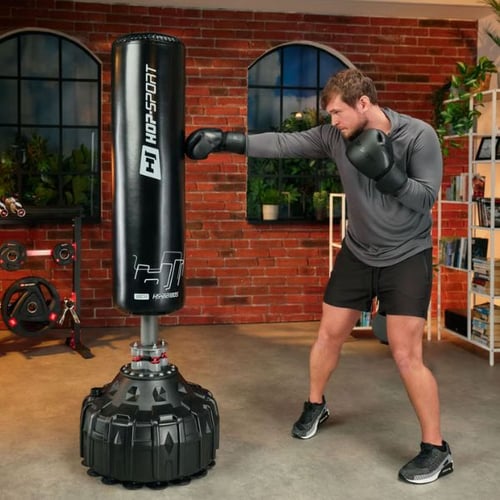
A free-standing punch bag skips the ceiling entirely – the weight sits in a base you fill with water or sand, and the target rises from it on a flexible neck. Our HS-BB170S works that way at 170 × 26 cm, with 12 suction cups gripping the floor and 360° rotation that keeps the target facing you as you circle it.
Three things decide how steady a standing model feels:
- Base filling – water drains and moves easily, sand sits heavier under repeated contact
- Floor surface – suction cups need something even; a rug under the base prevents the suction cups from gripping
- Strike height – aim at the middle of the target, which keeps the sway sensible
The larger HS-BB180S in our range goes further on stability: four buffered springs and 25 suction cups, with a 180 × 32 cm target that gives a wider surface for body shots. Its anti-shock system damps vibration rather than fixing anyone's technique, and the card calls the model an alternative to a traditional hanging bag, since no ceiling mounting is involved. For martial arts practice at home, that is often the whole argument.
Heavy Bag: The Classic Choice for Boxing Training
The word heavy describes resistance, not a mounting system – a common source of confusion. A heavy bag barely moves under a clean shot, so it teaches you to put your weight behind the punch instead of pushing with the arm. That resistance keeps it at the centre of boxing training in almost every club.
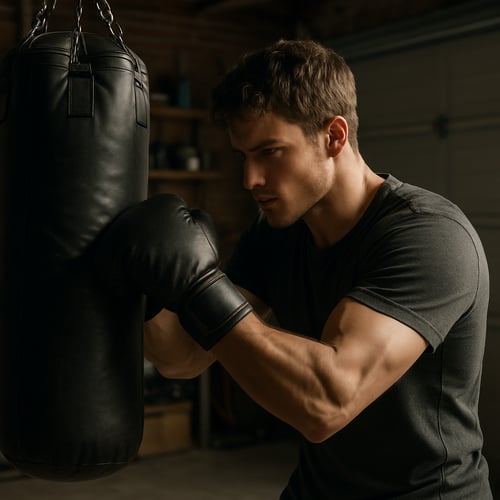
Boxing gloves, or at minimum well-wrapped hands, protect knuckles and wrists, and rounds work better with a purpose – three minutes of one planned combination do more than ten minutes of random punching. Technique repeats itself on a bag, good or bad, so film a round now and then and check whether your guard drops as you get tired.
Hanging Punch Bag: Benefits, Limitations and Installation
A hanging punch bag swings, and the swing is the point: it moves away from a shot and returns on a rhythm you have to read. Footwork improves almost by accident. The trade-off is the mounting, because a heavy punch bag loads its fixing with far more than its own weight.
Check these six points before anything gets bolted in:
- Structure – a load-bearing beam or joist, confirmed rather than assumed
- Bracket – rated fixings and tight bolts, never an improvised hook
- Straps and chains – checked for fraying every few sessions
- Clearance – full swing space in every direction, including behind you
- Height – the middle of the bag around chest level for hand work
- Noise – vibration travels through a ceiling in a shared building
Clubs use hanging bags for years without problems, yet a rented flat or a low garage often rules them out. Where the structure cannot take a fixing, a standing model is the straightforward swap – no drilling and no permanent installation required.
Kickboxing and Muay Thai Bags: What Makes Them Different?
The difference comes down to length and hanging height. A kickboxing bag extends the striking surface downwards so low kicks land on the target instead of thin air, and a Muay Thai bag, the banana shape, runs longer still, leaving room for knees, teeps and level changes mid-round.
Sizes are set by each manufacturer, not by a universal standard, so two bags sharing a label can behave differently. Density matters as much as length: kicks deliver force through a far larger contact area than a fist. When sessions mix hands and legs, height matters more than width.
Speed Bag Boxing: Improving Rhythm and Hand-Eye Coordination
A speed bag rebounds off a platform in a steady triple beat, and the skill lies in keeping that beat rather than in hitting hard. Speed bag boxing drills train timing and hand eye coordination, and they expose tension immediately – tight shoulders, and the rhythm collapses within a few strikes.
Treat it as a change of pace inside a session rather than the session itself. Two or three minutes between heavier rounds keeps the hands quick and adds variety to the session. Research on boxing treats coordination and reaction speed as genuine skills, though nobody claims a platform bag alone wins rounds.
Wrecking Ball and Bowling Pin Punch Bags Explained
These shapes exist because a straight cylinder does not suit every strike. A wrecking ball is round and broad, sitting near torso height, which opens clean angles for uppercuts, hooks and short shots from close range. A punch also slides off the rounded surface when the angle is wrong, and that feedback teaches plenty.
A bowling pin punch bag narrows towards the top and widens lower down, following the outline of a body. That suits mixed-height work: knees into the wide section, hooks around the narrow neck, clinch drills using the whole shape. Both designs sit alongside a main bag rather than replacing it.
Matching the Bag to the Training You Enjoy
Across the different types of punching bags, the pattern is simpler than any catalogue suggests. Mounting decides what is possible in your room, shape decides which strikes make sense, and filling decides how contact feels. Hanging designs give swing and honest feedback when the ceiling allows it, while standing designs deliver the same drills without touching the structure. Which route suits your space – something bolted overhead, or something you fill, use and roll aside? If it is the second, our free-standing pair was built for exactly that!
FAQ: Most Common Questions About Punching Bags
Which Type Suits a Small Flat Best?
A free-standing model is usually the practical answer because it needs no ceiling fixing and moves aside after a session. Give it an even floor, a clear circle and a properly filled base.
Do Free-Standing Bags Slide Across the Floor?
A filled base with suction cups on an even, clean surface stays where you put it during normal training. Sliding almost always means an underfilled base, a rug or dust under the cups.
Can a Punching Bag Be Kept Outdoors?
Only equipment carrying an explicit weather and UV rating belongs outside permanently, and most home bags do not have one. A garden session on a dry day is fine if the bag comes back indoors.
How Often Should the Base or Fixing Be Checked?
A quick look before each session and a proper check every few weeks cover both systems – water level and cup contact on a standing model, bolts and strap wear on a mounted one.
Author: Hop-Sport Team