Home Workout
Exercise Bikes for Weight Loss: How Effective Are They?

-23% £170.00
£130.99

-22% £100.00
£77.99


-21% £520.00
£412.99


£100.00


£170.00
Exercise bikes are one of the most practical and effective ways to boost your fitness from home. Whether you want a compact exercise bike, a recumbent bike for added comfort, or the best exercise bike for improving strength and stamina, modern home exercise bikes offer smooth, low-impact training that fits any lifestyle.
Explore our exercise bikes for sale and find an exercise bike for home training that matches your space, fitness level and preferred riding position. Indoor exercise bikes, sometimes described more generally as a cycling machine or static bike, allow you to train consistently without depending on the weather or travelling to a gym.
A stationary bike allows you to train consistently, whatever the weather, while being gentle on your joints. Today’s exercise bikes for home are designed for comfort, performance, and ease of use, making them ideal for beginners and seasoned athletes alike.
Key exercise bike benefits include:
Whether you prefer upright exercise bikes for a classic riding position or a small exercise bike to save space, every option helps you stay active and motivated.
The best exercise bikes for home depend on your space, training style, and preferred comfort level.
Ideal for traditional cycling posture. Great for cardiovascular fitness, toning the lower body, and improving endurance. A strong all-round choice for most home gyms.
Designed with a supportive seat and backrest. These bikes reduce pressure on the lower back and hips, making them ideal for longer rides or users who prefer enhanced comfort.
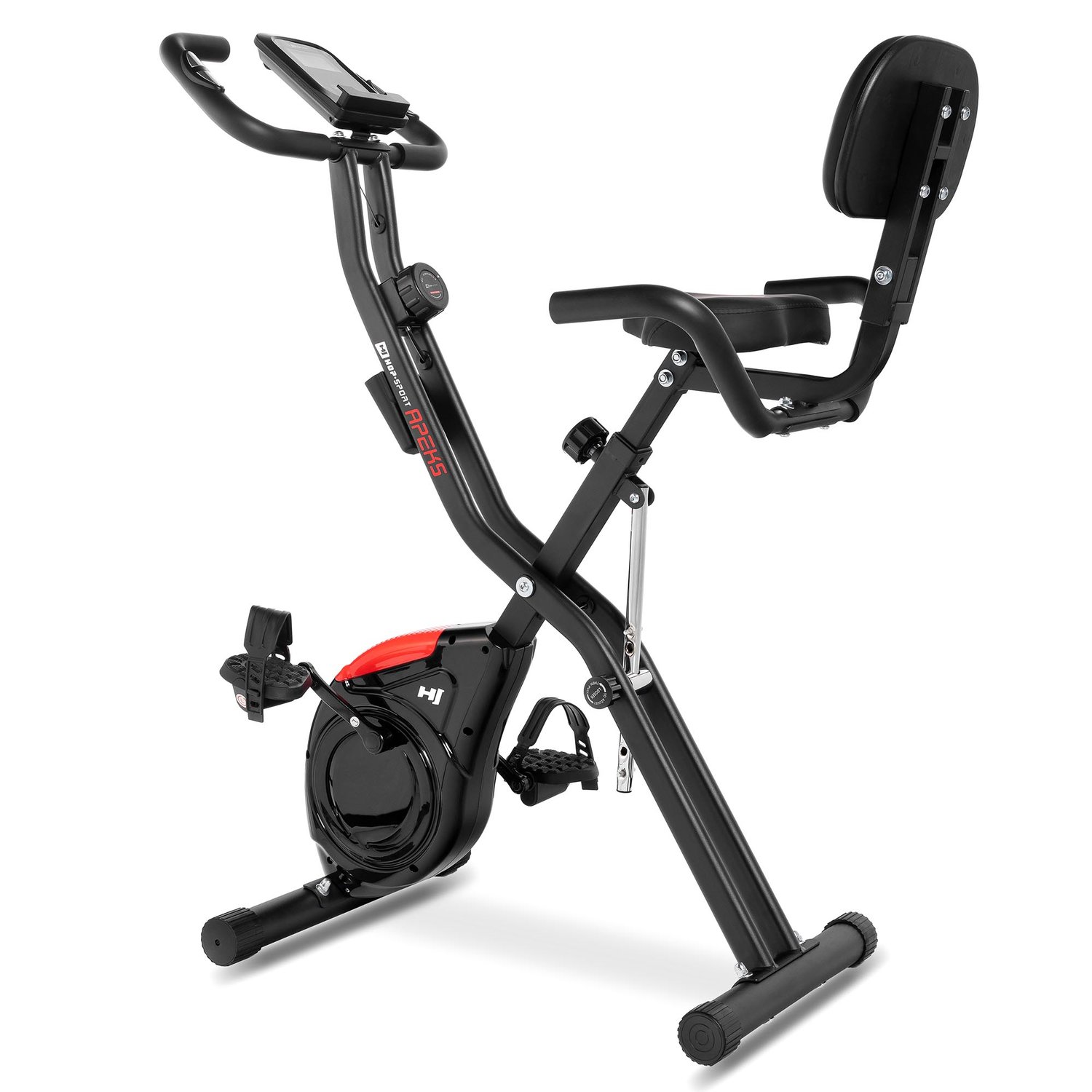
A compact exercise bike or folding model suits smaller homes, flats, or shared spaces. Easy to move and store, yet still effective for daily fitness.
The best folding exercise bikes combine a stable frame with a practical mechanism that reduces the amount of storage space required. A folding exercise bike, sometimes called a foldable exercise bike, can be a particularly useful choice for a flat, shared room or small home gym.
Are folding exercise bikes any good? They can provide effective cardio training, but it is still important to check the resistance range, maximum user weight, adjustment options and stability of the frame. Compact dimensions should not come at the expense of a comfortable riding position.
Spin exercise bikes are designed to create a more performance-focused riding experience. A spin bike, often referred to as a spinning bike, usually has a heavier flywheel and a riding position inspired by road cycling. A mini exercise bike is different again: it is a small pedal exerciser used while sitting on a separate chair rather than a complete stationary bike.
Yes. An exercise bike for weight loss is one of the most efficient home-fitness tools. Regular cycling helps you:
Pairing cycling sessions with a balanced diet accelerates results. The number of calories burned depends on body weight, resistance, pace, workout duration and individual fitness. Displays built into exercise bikes provide useful estimates, but their calorie readings should not be treated as exact measurements. Explore this topic: Exercise Bikes for Weight Loss: How Effective Are They?
What muscles do exercise bikes work? A home exercise bike works multiple major muscle groups:
This makes cycling a full-body conditioning workout, not just a leg exercise.
Calorie burn varies based on resistance, pace, and rider weight. On average:
A stationary bike makes it easy to track your performance using built-in displays and training programs. Cross trainers offer similar benefits, delivering a full-body, low-impact workout that engages both the upper and lower body, helping you burn calories efficiently while reducing stress on the joints.
The main benefits of exercise bike training include the convenience of effective home workouts and the advantage of low-impact movement that is suitable for daily use. An exercise bike gives you full control over your effort and resistance levels, allowing you to tailor each session to your goals. Many models feature compact designs ideal for smaller UK homes, along with quiet operation that fits comfortably into shared living spaces.
Onboard displays provide accurate performance tracking to keep you motivated and informed, while the overall versatility of an exercise bike makes it suitable for weight loss, muscle toning, and cardiovascular improvement.
Modern Hop-Sport home exercise bikes feature:
These features make every ride comfortable, controlled, and efficient.
Whether you're starting your fitness journey or upgrading your home gym, here you’ll find the best exercise bike to suit your goals. Choose from upright or compact models, all designed to support long-term progress and enjoyable home training.
Cycling supports overall fat reduction, including fat around the abdomen, by helping you burn calories consistently, raise your heart rate, and improve metabolic efficiency. While spot-reduction isn’t possible, regular sessions on an exercise bike combined with core strengthening exercises and balanced nutrition can gradually lead to a slimmer, stronger midsection.
Indoor cycling is a highly effective form of exercise because it improves cardiovascular endurance, increases lower-body strength, enhances lung capacity, and boosts overall fitness levels. A home exercise bike provides all of these benefits without the challenges of outdoor cycling, such as weather, traffic, or uneven terrain.
Yes, an exercise bike is an excellent choice for beginners. Exercise bikes across the UK are popular with new users because they are simple to operate, low-impact on the joints, and easy to adapt to different fitness levels. They also allow safe, controlled training at home without supervision. Many beginners choose upright exercise bikes or compact exercise bikes because these models offer a straightforward, versatile introduction to indoor cycling.
For general weight loss, aim for around 30 minutes of cycling per session, ideally 4–5 times per week. Gradually increasing the resistance helps improve calorie burn, while mixing steady-state rides with interval training can make fat loss more effective. Even shorter sessions on a small exercise bike can still contribute meaningfully to your daily activity goals.
The ideal time to ride a stationary bike each day depends on your goal. For general fitness, about 20 to 30 minutes at a moderate pace is usually enough. If you want to lose weight, aim for 30 to 60 minutes and include some higher-intensity intervals. For building endurance, longer sessions of up to 90 minutes may be suitable. If you are a beginner, start with 10 to 15 minutes and gradually increase over time. Consistency is key, so it is better to ride for a shorter time regularly than to do longer sessions occasionally.
Light flywheels (4 kg to 7 kg) are best suited for beginners, light rehab work, or gentle daily workouts. Heavy flywheels (8 kg to 18 kg+) provide higher maximum resistance and a much smoother, realistic road-cycling feel during intense training.
Manual magnetic resistance is adjusted using a mechanical dial on the frame and requires no mains electricity connection. Electronic magnetic resistance is controlled directly from the digital console, allowing for precise resistance levels and automated workout programmes.